Updated 2026-11-25 · 10 min read
You can build a model rocket in a few evenings. What takes the time is learning the rules and doing the checks that make it safe to launch. This page is the map: each step links to a longer guide. NOVTAR is building its first rocket, NOVTAR Solace, step by step, so it is the worked example throughout. Solace is in build and has not flown, so everything about it here is a design or a plan. This is not legal advice: read the UKRA Safety Code and follow your club and its Range Safety Officer.
The law in one page
UKRA, the UK Rocketry Association, publishes a plain page on what is legal. Its main points:
- Flying rockets is not itself illegal. Many rocket motors can be bought, stored and flown without certification or approval, but you should ask your seller, because some motors have legal requirements, and most motors cannot be bought by minors.
- You have a legal duty not to endanger people, property or aircraft, and you must not fly into controlled airspace. Both come from the Civil Aviation Authority's Air Navigation Order.
- For that order, rockets are sorted by total impulse at launch into three groups.
UKRA treats low power (A to E) and medium power (F to G) as model rockets and recommends flying them under its Model Rocket Safety Code. It does not recommend flying small rockets outside a club. NOVTAR Solace is designed for a certified 29 mm motor of F or small G class, which is a model rocket by these rules. To understand the letters, see motor codes explained.
Step 1: find a club and arrange insurance
UKRA keeps a list of clubs, and the Safety Code says insurance should be in place for all flights, with the British Model Flying Association (BMFA) offering a package for rocketry that follows the code. A club also gives you the thing a guide cannot: people who have done this before. EARS, the East Anglian Rocketry Society, advises beginners to start with a starter set, and a club is the best place to ask which one. See joining UKRA and finding a club.
Step 2: learn how a club launch works
The Range Safety Officer (RSO) inspects every rocket and can refuse any flight, and the flier must be able to answer their questions about the design. See flying at a UKRA club launch and how a launch site is set up.
Step 3: choose a design that is stable
The Safety Code asks for a rocket that is passively stable in every phase of flight, with the centre of pressure at least one body diameter behind the centre of gravity at all stages. For Solace the design file puts the CG at 449.7 mm and the CP at 558 mm from the nose tip with the motor loaded, which is an estimated margin of 1.9 calibres. See how to check stability.
Step 4: choose a certified motor
Under UK law all solid propellant motors are explosives, so the Safety Code says every solid motor must be commercially made and meet current law, including labelling. No flier may launch a rocket on a non-commercial solid motor. The average thrust must be more than three times the weight of the rocket, and UKRA recommends five to ten times. For Solace's estimated 586 g loaded, the design asks for at least 28.7 N. An adult or the club buys, stores and fits the motor. The sums are in motor codes explained and launch rails and thrust-to-weight.
Step 5: build it strongly enough
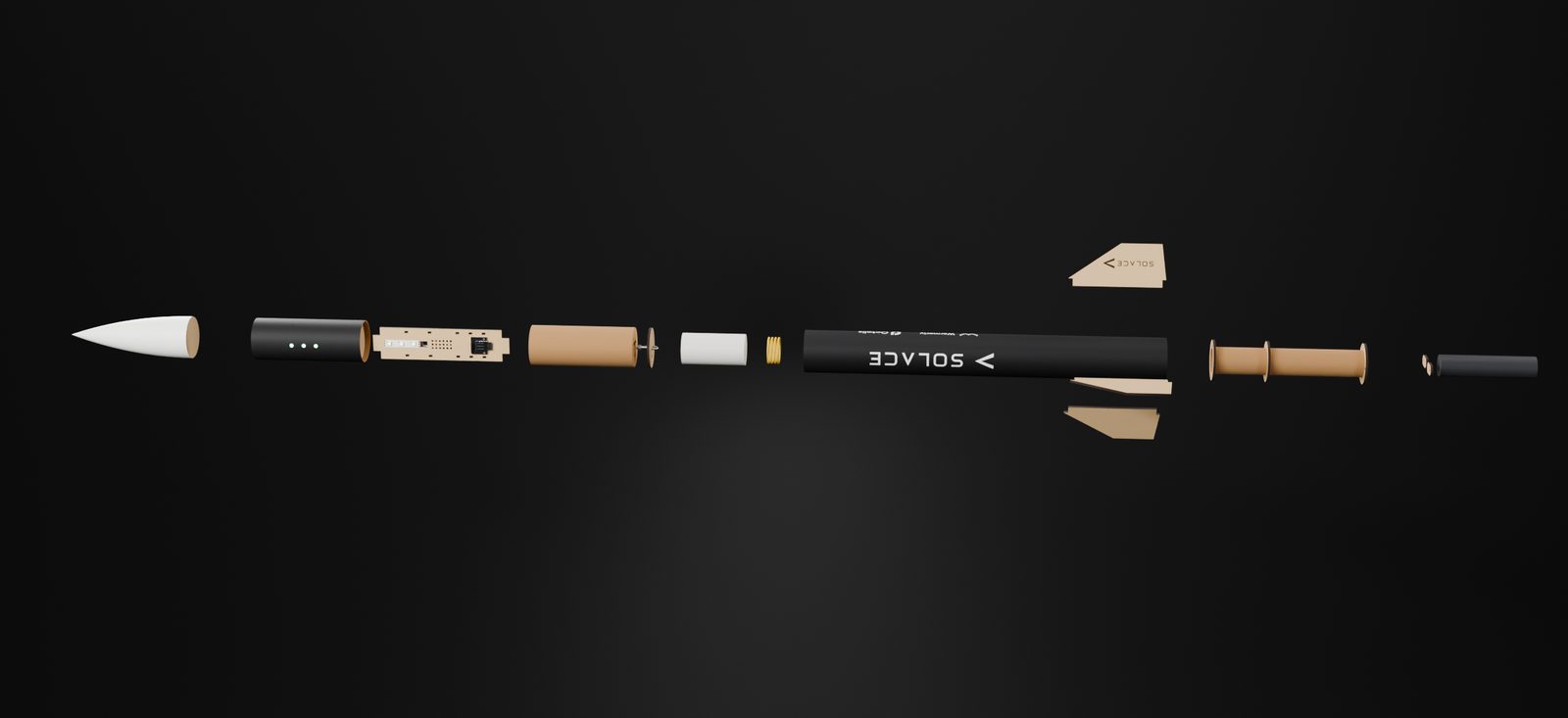
The code asks for materials and joints suited to the forces of flight, no unnecessary metal parts, and no sharp edges on nose cones or fins. Here is how Solace's 800 mm is made up:
From the Solace design file. The nose also has a 40 mm shoulder that fits inside the payload tube, and the 200 mm motor mount sits inside the booster tube. The design uses 3.2 mm plywood parts and kraft cardboard tubes about 57 mm across.
Source: NOVTAR Solace build book and design file (design values, not a built rocket).
Data table
| Item | mm |
|---|---|
| Nose cone | 170 |
| Payload tube (avionics bay) | 150 |
| Booster tube (parachute, motor mount, fins) | 480 |
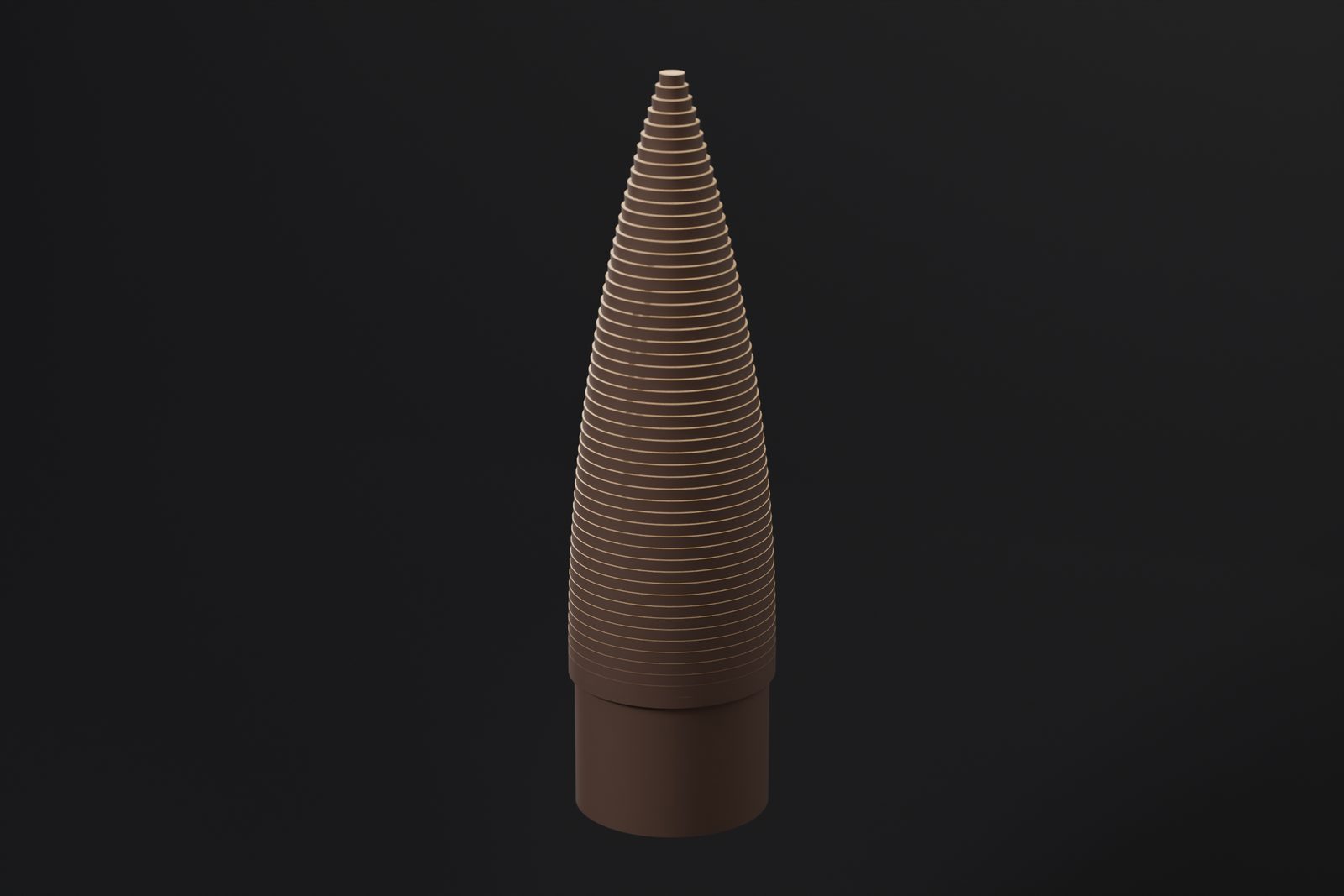
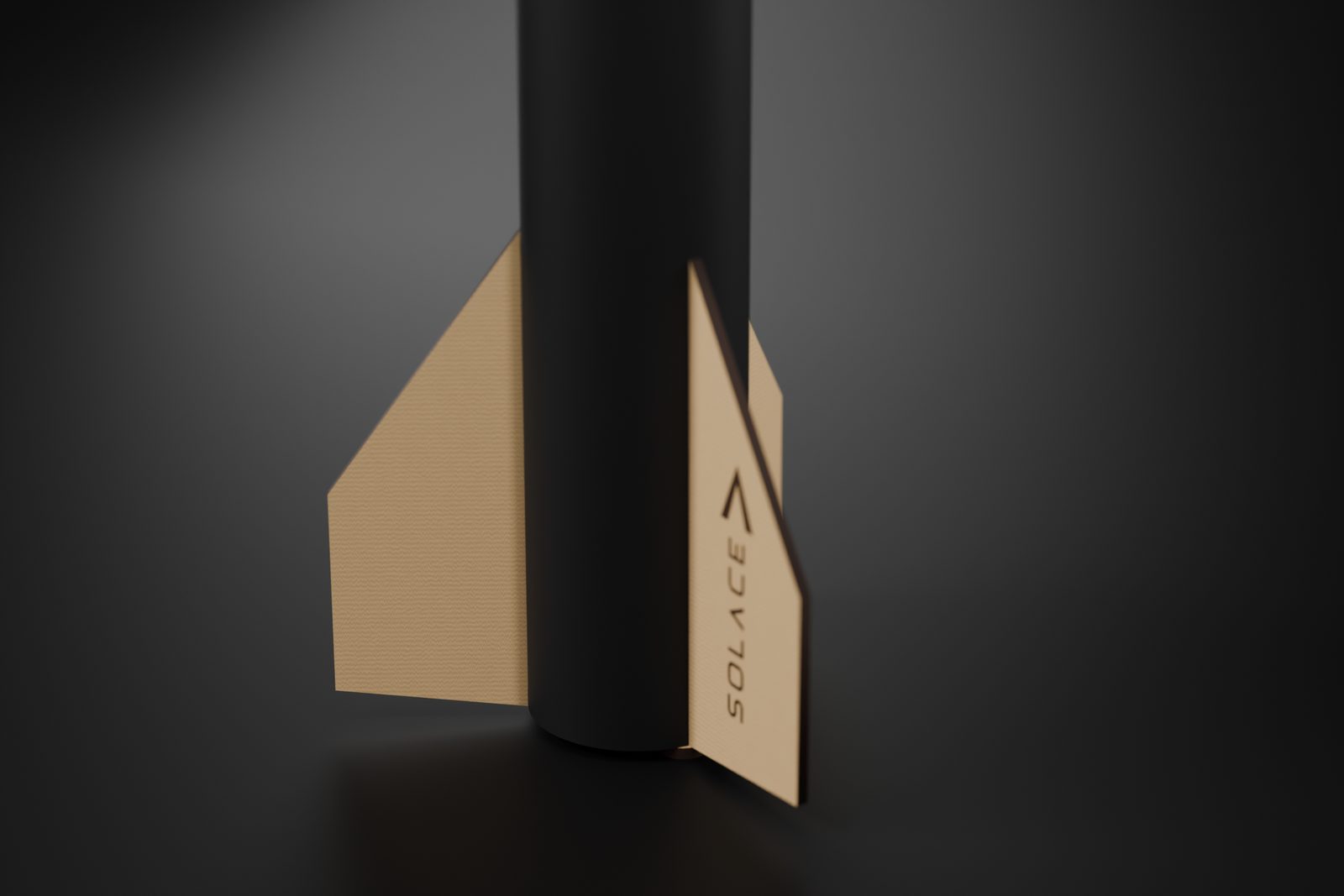
Solace's build book lists the parts: the nose is a stack of laser-cut plywood rings on a dowel, sanded to shape. The tubes are cardboard on purpose, because PVC pipe is several times heavier, which changes the stability and the motor you need. The motor mount is a 29 mm tube with three centring rings and motor clips. The three plywood fins pass through slots and are epoxied to the motor tube. If you have a laser cutter, see laser cutting plywood fins.
Step 6: plan the recovery
Every part must come back so it can fly again, and the recovery system must be protected from the heat and forces of flight. The code points to heat insulation such as wadding between an ejection charge and the parachute, ground testing anything untested, and a recovery device that suits the landing site. Solace's design has a 67 cm nylon parachute, a Kevlar cord where it meets the motor heat, elastic shock cord and a flame-proof blanket, and its descent speed is an estimate of 5.5 m/s. The motor's own ejection charge puts the parachute out. See recovery under the UKRA code.
Step 7: add electronics only if you need them
A flight computer can log the flight and send live data. Solace's measures only and fires nothing. It has a Heltec V3 board, a barometer, a motion sensor and a battery. See how a barometer altimeter works, LoRa telemetry for a model rocket and our flight computer. A rocket that steers itself is not an ordinary club flight: the UKRA code says active stabilisation can only be flown as a Research/Experimental flight.
Step 8: cut and assemble
Solace's build book is a step-by-step guide. In outline, the order is: measure every tube and put the real numbers into the design, cut the tubes to length, mark and cut the fin slots, build and fit the motor mount, glue the fins in a jig, add the fillets and rail buttons, and carry on through the recovery gear and the avionics bay. The build book also gives the laser safety rules: wear the right glasses, vent the smoke outside, keep a fire extinguisher or blanket within reach, never leave the laser running, and cut only plywood, paper and card, never PVC or vinyl. Read the Solace build book for the parts list and the steps.
Step 9: check it before launch day
Inspect for damage, confirm the balance and stability with the motor fitted, and be ready to answer the RSO's questions. Solace has a printable flight card with boxes for the measured mass and balance point, the stability with the real motor, the motor and its certification, and the RSO's sign-off. The launch day page lists what to ask your club.
What not to do
- Do not make your own propellant or motors. The code says no flier may launch a rocket on a non-commercial solid motor.
- Do not fly in winds above 20 mph. UKRA recommends not flying above 15 mph.
- Do not fly on public land, or anywhere you cannot control other users. UKRA says to fly only on private land with the owner's permission.
- Do not launch without the Range Safety Officer's approval.
- Do not add active stabilisation and expect an ordinary club flight.
Questions
Is it legal to build a model rocket in the UK?
Yes. UKRA says flying rockets is not itself illegal and many motors can be bought, stored and flown without certification. You still must not endanger people, property or aircraft, and you must not fly into controlled airspace, under the Civil Aviation Authority's Air Navigation Order.
Do I need a licence to launch a model rocket in the UK?
UKRA says many rocket motors can be bought, stored and flown without certification or approval, and model rockets under 160 N·s are not subject to CAA rules beyond the general ones. Ask your seller about the motor you are buying, because some have legal requirements. Higher power rockets need certification at a UKRA club.
Can under-18s buy rocket motors?
UKRA says most rocket motors cannot be purchased by minors. Ask your seller. At NOVTAR an adult or the club buys, stores and fits the motor.
Can I make my own rocket motor in the UK?
Not for solid propellant. The UKRA Safety Code says no flier may launch a rocket on a non-commercial solid motor, because solid motors are explosives and must be made at registered sites.
Where can I launch a model rocket in the UK?
UKRA recommends visiting clubs, and says if you fly alone you should only use private land with the owner's permission, where you can control other users and a NOTAM has been issued. A club launch handles all of that for you.
What glue should I use to build a model rocket?
Estes says white glue suits porous parts such as paper and balsa, including motor mounts, fins, launch lugs and fillets. Aliphatic (wood) glue is stronger and dries faster. Plastic parts need plastic cement, and epoxy gives extra strength for high-thrust kits. Super glue bonds skin instantly, so Estes says never to let unsupervised children use it, and to wear eye protection and gloves.
What tools do I need to build a model rocket?
Estes lists a modelling knife, scissors, a ruler, masking tape, fine and extra fine sandpaper, white or carpenter's glue, tube-type plastic cement, and spray primer and paint. Use a cutting board under the knife, because modelling knives are very sharp.
How do I make a model rocket stable?
Keep the centre of gravity at least one body diameter ahead of the centre of pressure, with the motor fitted. Add weight to the nose or make the fins bigger if it fails.
If you are wondering where to shop, see where to buy model rockets and motors in the UK.
For further reading, see books and references UKRA lists.
For why the parachute needs protecting from the ejection charge, see what is recovery wadding.
To see how the motor is held in, read how a motor is held in a model rocket.
For the fin step in detail, see how to attach fins to a model rocket.
Where to go next
- Is model rocketry safe?
- How to cut a model rocket body tube neatly
- What glue should you use on a model rocket?
- Model rocket in a garden or park? UK rules
- Parts of a model rocket, and what each one does
- Model rocket stability
- Model rocket motor codes explained
- Recovery under the UKRA code
- Launch rails and thrust-to-weight
- How a barometer altimeter works
- The avionics bay: what goes in it
- UKRA Model Achievement Programme (MAP) explained
- LoRa telemetry for a model rocket
- The NOVTAR safety page