Updated 2026-11-27 · 14 min read
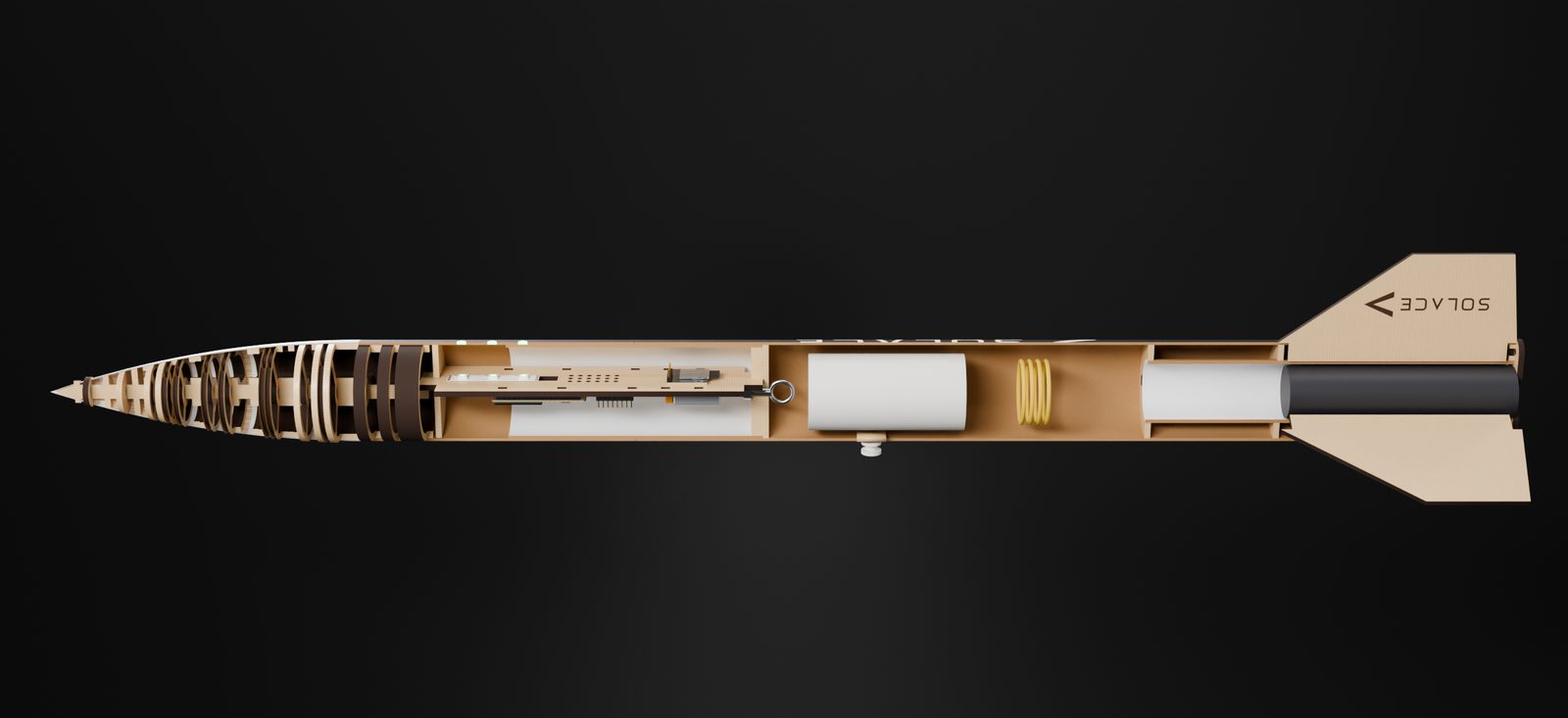
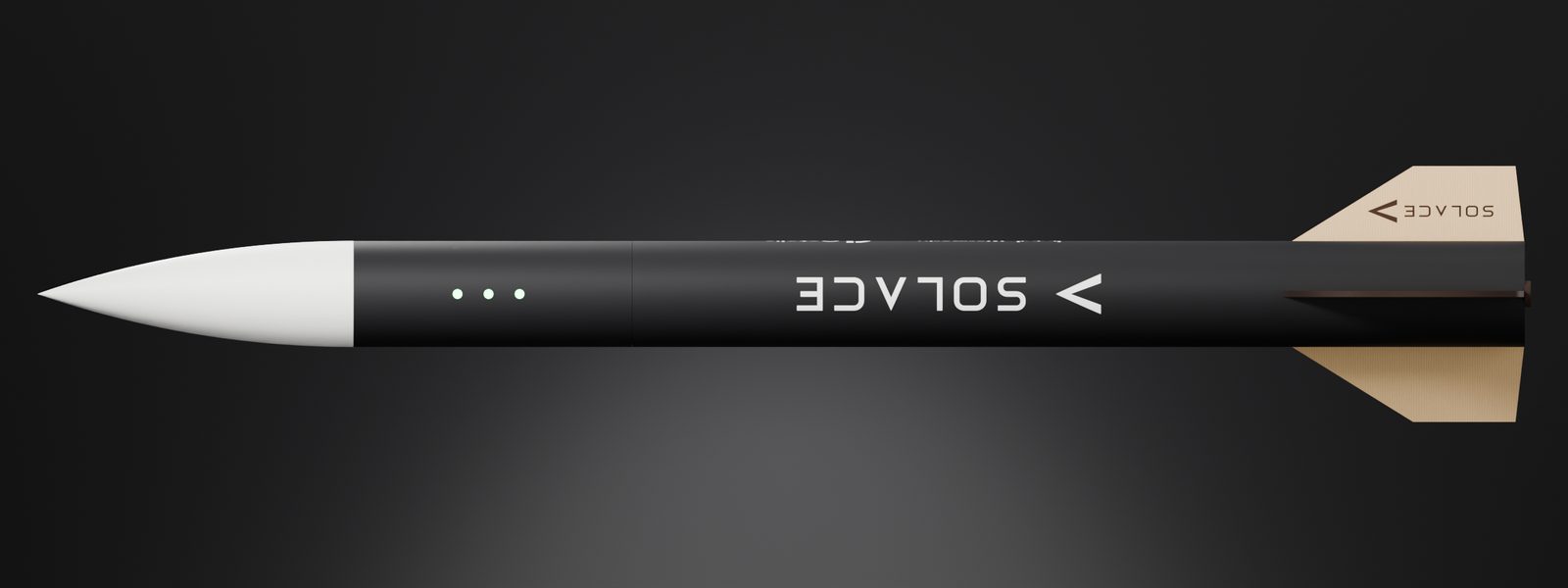
If you are building your first model rocket, the code printed on the side of the motor is the first thing to learn to read. It tells you how hard the motor pushes, for how long, and when the recovery system fires. This guide explains each part, shows the impulse classes as a chart, covers the UK rules, and finishes with a worked example from NOVTAR Solace, our first model rocket, which is being built for a certified 29 mm motor. Solace has not flown yet, so every number about it below is a design estimate.
How to read a motor code
Take C6-5. It breaks into three parts.
| Part | In C6-5 | What it tells you |
|---|---|---|
| The letter | C | The total impulse class: all the push the motor gives, added up over the burn. |
| The first number | 6 | The average thrust, in newtons (N). |
| The number after the dash | 5 | The delay, in seconds, between the end of the burn and the ejection charge. |
NASA Glenn describes the same three parts: the first number is the average thrust, "the average thrust times the burn time of the engine is called the total impulse", and the delay is the time between engine cutoff and the firing of the ejection charge. Estes, a maker of model rocket motors, gives the same reading on its help page, and Wikipedia uses C6-3 as its worked example: between 5.01 and 10 N·s of impulse, 6 N average thrust, and an ejection charge 3 seconds after burnout.
The letter: total impulse
Total impulse is thrust added up over the whole burn, measured in newton-seconds (N·s). A bigger letter means more energy in the motor. Each class has up to twice the impulse of the one before, so a D motor is up to twice a C, and a G is up to eight times a D.
Source: NASA Glenn (A to D) and the Wikipedia classification table (1/2A to G). The ranges double at each step.
Data table
| Item | N·s |
|---|---|
| 1/2A | 1.25 |
| A | 2.5 |
| B | 5 |
| C | 10 |
| D | 20 |
| E | 40 |
| F | 80 |
| G | 160 |
The same ranges as a table, with the bottom of each class:
| Class | Total impulse (N·s) | Power level |
|---|---|---|
| 1/2A | 0.626 to 1.25 | Low power |
| A | 1.26 to 2.50 | Low power |
| B | 2.51 to 5.00 | Low power |
| C | 5.01 to 10.0 | Low power |
| D | 10.01 to 20.0 | Low power |
| E | 20.01 to 40.0 | Low power |
| F | 40.01 to 80.0 | Mid power |
| G | 80.01 to 160 | Mid power |
| H and above | 160.01 and up | High power |
Wikipedia groups E and below as low power, F and G as mid power, and H and above as high power, and says the page needs more citations, so treat the groupings as a guide. NASA Glenn gives the top of the first classes (A is 2.5, B is 5, C is 10, D is 20 N·s), and those match. We could not read the National Association of Rocketry (NAR) pages from our server, so check the maker's data sheet for the exact impulse of any motor you buy.
In the UK, the UKRA Safety Code covers rocket launches up to and including O class (O is the class above 20,480 N·s). A model rocket under the code is outside its High Power Rocketry section, which has extra rules, so a flier moving up from model rockets should read that section before choosing an H motor or above.
The first number: average thrust
The first number is the average push in newtons. A C6 and a B6 have the same average thrust of 6 N, but NASA points out that the C burns almost twice as long, for twice the total impulse. Thrust is not constant through a burn, so the average is a summary. NASA's performance curves show the thrust rising and falling, with the average drawn as a dashed line.
You can turn the two numbers into a rough burn time, because total impulse is average thrust multiplied by burn time:
Worked out from NASA's rule (total impulse = average thrust x burn time) using the top of each class. This is our arithmetic, not a measured figure. Real burn times are shorter whenever the motor sits lower in its class.
Source: NASA Glenn for the rule, the Wikipedia classification table for the class limits.
Data table
| Item | s |
|---|---|
| 1/2A | 0.21 |
| A | 0.42 |
| B | 0.83 |
| C | 1.67 |
| D | 3.33 |
So a C6 burns for somewhere up to about 1.7 seconds, and a B6 for under a second. Higher average thrust gets a heavy rocket off the rail faster, which matters for the next section.
How much thrust does a rocket need?
The UKRA Safety Code sets a minimum. The average thrust of the motor must, at all stages of flight, be more than three times the weight of the rocket as it is propelled. UKRA recommends between 5 and 10 times the weight. Weight here means the whole rocket, motor included, ready to fly.
The worked example is NOVTAR Solace. Its design estimate for the loaded rocket with the Heltec flight computer is 586 g. That is an estimate from the design file, not a weighed rocket.
- Weight is mass times gravity: 0.586 kg x 9.81 m/s² is about 5.75 N.
- The code's minimum is more than 3 times that, about 17.2 N.
- The recommended range is 5 to 10 times, about 28.7 N to 57.5 N.
Solace figures use the design's estimated loaded mass of 586 g and are estimates. The C6 bar is the average thrust of a C6 motor from NASA Glenn.
Source: UKRA Safety Code section 4.4 for the 3 times minimum and 5 to 10 times recommendation. NOVTAR design file for the mass.
Data table
| Item | N |
|---|---|
| A C6 motor | 6 |
| UKRA minimum (3x) | 17.2 |
| Solace target (5x) | 28.7 |
| Top of UKRA range (10x) | 57.5 |
A C6 gives 6 N. That is a third of the legal minimum for Solace, so a C-class motor is far too weak for this rocket. Our design target is 5 times its weight, which is the bottom of UKRA's recommended range. In the build book we aim for a certified 29 mm motor of F or small G class, and we pick the exact motor with the club. You can run the same sum for any rocket you build: weigh it fully loaded, multiply the mass in kilograms by 9.81, then check the motor's average thrust against 3 times, 5 times and 10 times that.
The last number: the delay
The motor does not just stop. After the propellant burns out, the rocket coasts upward, and then a small ejection charge in the motor pushes out the recovery system, usually a parachute. The last number in the code is the delay before that charge fires. A C6-5 waits 5 seconds after burnout.
NASA Glenn explains why it matters:
- If the delay is too short, the parachute comes out on the way up and can stop the flight.
- If it is too long, the rocket may hit the ground before the parachute opens.
Estes adds that choosing the right delay lets the rocket reach its highest point, which in most cases is the best time to deploy. Two special endings are worth knowing. A code ending in 0 has no delay and is used for booster stages and special purposes. A code ending in P has no delay and no ejection charge, and the front is plugged so no hot gas leaves from it.
For NOVTAR Solace, the motor's own ejection charge is the main way the parachute comes out. The flight computer in Solace measures and logs the flight and fires nothing. The delay is chosen with the club in OpenRocket, which simulates the flight, so the parachute comes out near the top. For how a launch is recovered safely, see recovery under the UKRA code.
What size are model rocket motors?
Standard model rocket motors come in three diameters: 13 mm, 18 mm and 24 mm. A motor code says nothing about the diameter, but the motor must fit the mount in the rocket. NASA notes that typical 1/2A motors are 13 mm across, A, B and C motors 18 mm, and D motors 24 mm, and that a rocket built for one size will not take another. Rocketry for Schools, a UK supplier, lists the same three standard diameters and says 18 mm is the usual size in starter kits.
NOVTAR Solace uses a 29 mm motor mount, so it takes 29 mm motors only. The mount is a design, with a tube, three centring rings and clips. See the Solace page and the Solace build book for the design.
The UK rules for motors
Three rules matter most to a new flier.
- Solid motors must be commercial. The UKRA Safety Code says all solid propellant motors are classed as explosives under UK law and must be made at registered sites. No flier may launch a rocket on a non-commercial solid motor, and every solid motor must be commercially made and meet current law, including labelling.
- Liquid and home-made hybrids are Research/Experimental. (More in can you make your own rocket motor in the UK?.) A non-commercial hybrid motor, or a liquid engine, makes the flight Research/Experimental under section 8 of the code.
- Active stabilisation is Research/Experimental too. A rocket that steers itself in flight, such as one with thrust vector control, can only fly as a Research/Experimental flight.
NOVTAR does not make motors and does not use home-made propellant. Solace flies on a certified motor at a UKRA club launch, with the Range Safety Officer in charge. The code is the rulebook and the Range Safety Officer decides on the day: read the UKRA Safety Code.
A checklist before you buy a motor
- Check the kit or design for the motor diameter and the class it was built for.
- Weigh the rocket loaded, then work out 3 times, 5 times and 10 times its weight in newtons.
- Pick a motor whose average thrust is above the 3 times minimum and, if you can, inside the 5 to 10 times range.
- Choose a delay that matches the coast to the top, using a simulator and your club's advice.
- Buy a certified, labelled, commercially made motor from a reputable supplier, and let an adult or the club fit it.
- Check the rocket is stable with the motor loaded: centre of gravity and centre of pressure.
- Fly at a club launch: what happens at a UKRA club launch.
Questions
What is model rocket motor classification?
It is the letter system that groups motors by total impulse, the push they give added up over the whole burn, in newton-seconds. The classes run 1/2A, A, B, C, D, E, F, G and on, and each class has up to twice the impulse of the one before. A C motor gives 5.01 to 10 N·s and a D motor 10.01 to 20 N·s. In the UK every solid motor must be commercially made and certified.
What do the numbers on a model rocket motor mean?
The letter is the total impulse class, the first number is the average thrust in newtons, and the second number is the delay in seconds between burnout and the ejection charge. A C6-5 gives 5.01 to 10 N·s in total, pushes with 6 N on average, and fires its ejection charge 5 seconds after the burn ends.
What are the different classes of model rocket motors?
The classes run 1/2A, A, B, C, D, E, F, G and on through H to O. Each class has up to twice the total impulse of the one before. Wikipedia groups E and below as low power, F and G as mid power, and H and above as high power.
What is the strongest model rocket motor?
The UKRA Safety Code covers rockets up to and including O class, which tops out at 40,960 N·s. Model rockets use far smaller motors. The code treats anything above O class as Research/Experimental, and sets extra rules for high power rockets from H class upwards.
What does a 0 or a P at the end of a motor code mean?
According to Estes, a code ending in 0 has no timed delay and is used for booster stages and special purposes. A code ending in P has no delay and no ejection charge, and its front end is plugged.
What happens inside the motor during the delay?
After the propellant is used up, thrust drops to zero and a delay charge burns slowly while the rocket coasts to its highest point. NASA Glenn says delays run from 2 to 8 seconds and are printed on the casing. When the delay charge has burned through, the ejection charge fires and deploys the parachute.
How do I choose the delay time on a motor?
Estes says the right delay depends on how long your rocket takes to reach its highest point with that motor. The delay lets the rocket coast to the top before the recovery system deploys. Check the maker's motor chart for your rocket, and follow your club's Range Safety Officer.
Why does a B8 launch faster than a B4?
Both are B motors, so they have the same total impulse, says Estes. The B8 has the higher average thrust (8 newtons against 4), so it pushes harder and the rocket accelerates faster.
Can I make my own rocket motor in the UK?
Not for solid propellant. The UKRA Safety Code says no flier may launch a rocket on a non-commercial solid propellant motor, because solid motors are classed as explosives and must be made at registered sites.
What are the standard rocket motor sizes?
NASA says typical 1/2A motors are 13 mm across, A, B and C motors 18 mm, and D motors 24 mm, and that a rocket built for one size will not take another. Rocketry for Schools, a UK supplier, lists the same three diameters and says 18 mm is the usual starter kit size. The letter is the impulse class, not the diameter, so check both. NOVTAR Solace is a design for a 29 mm mount and has not flown.
What is the model rocket motor impulse chart?
It is the table of total impulse by class, in newton-seconds: 1/2A is 0.626 to 1.25, A is 1.26 to 2.50, B is 2.51 to 5.00, C is 5.01 to 10.0, D is 10.01 to 20.0, E is 20.01 to 40.0, F is 40.01 to 80.0, G is 80.01 to 160, and H and above is 160.01 and up. Each class tops out at about twice the one before. The figures are from the Wikipedia classification table, and NASA Glenn's A to D tops match; check the maker's data sheet for any motor you buy.
How much thrust does a model rocket need?
Under the UKRA Safety Code the average thrust must be more than three times the weight of the rocket at all stages of flight, and UKRA recommends 5 to 10 times. For a rocket weighing 586 g that is more than about 17.2 N, and 28.7 to 57.5 N recommended.
For what the delay and ejection charges inside a motor do, see what is inside a model rocket motor.
A zero-delay motor is the kind a booster stage uses; see how a two-stage model rocket works.
For the whole flight sequence, see what happens in a model rocket flight.
Where to go next
- Model rocket vs high power rocket: UK classes
- What happens in a model rocket flight, step by step
- How to read a model rocket thrust curve
- How to build a model rocket in the UK
- Launch rails and thrust-to-weight
- Joining UKRA and finding a club
- How a flight computer logs the flight
Sources
- https://www1.grc.nasa.gov/beginners-guide-to-aeronautics/model-rocket-engine-designation
- https://help.estesrockets.com/article/47-what-do-the-engine-codes-mean
- https://en.wikipedia.org/wiki/Model_rocket_motor_classification
- https://www.ukra.org.uk/safety-code
- https://rocketryforschools.co.uk/blogs/rocketry-guides/model-rocket-motors-explained-types-sizes