Updated 2026-11-21 · 5 min read
In short: a model rocket must be guided up a rod or rail until it is fast enough to fly straight, the rail must be within 20 degrees of vertical, and the motor's average thrust must be more than three times the weight of the rocket. These are rules in the UKRA Safety Code. NOVTAR Solace, our first model rocket, is being designed to them. It has not flown yet.
The rail (section 5.3)
The code says every rocket must launch from a launchpad or rail that meets these points:
- The rocket is guided along the whole length of the rod or rail, with a launch lug or rail button.
- The rod or rail is long enough for the rocket to reach a stable flight speed before the lug or button leaves it.
- It is rigid enough that the rocket climbs it without significant flex, at any wind speed you expect.
- Fliers and spectators are protected, for example by a cap on a rod whose top is below eye level.
- The ground and the launch equipment are protected from the motor's hot gas. The code says to consider a blast deflector.
- It is within 20 degrees of vertical, except for rockets that gain lift from wings, such as boosted gliders.
- The area is clear of flammable material such as dry grass or crop to a radius of three metres.
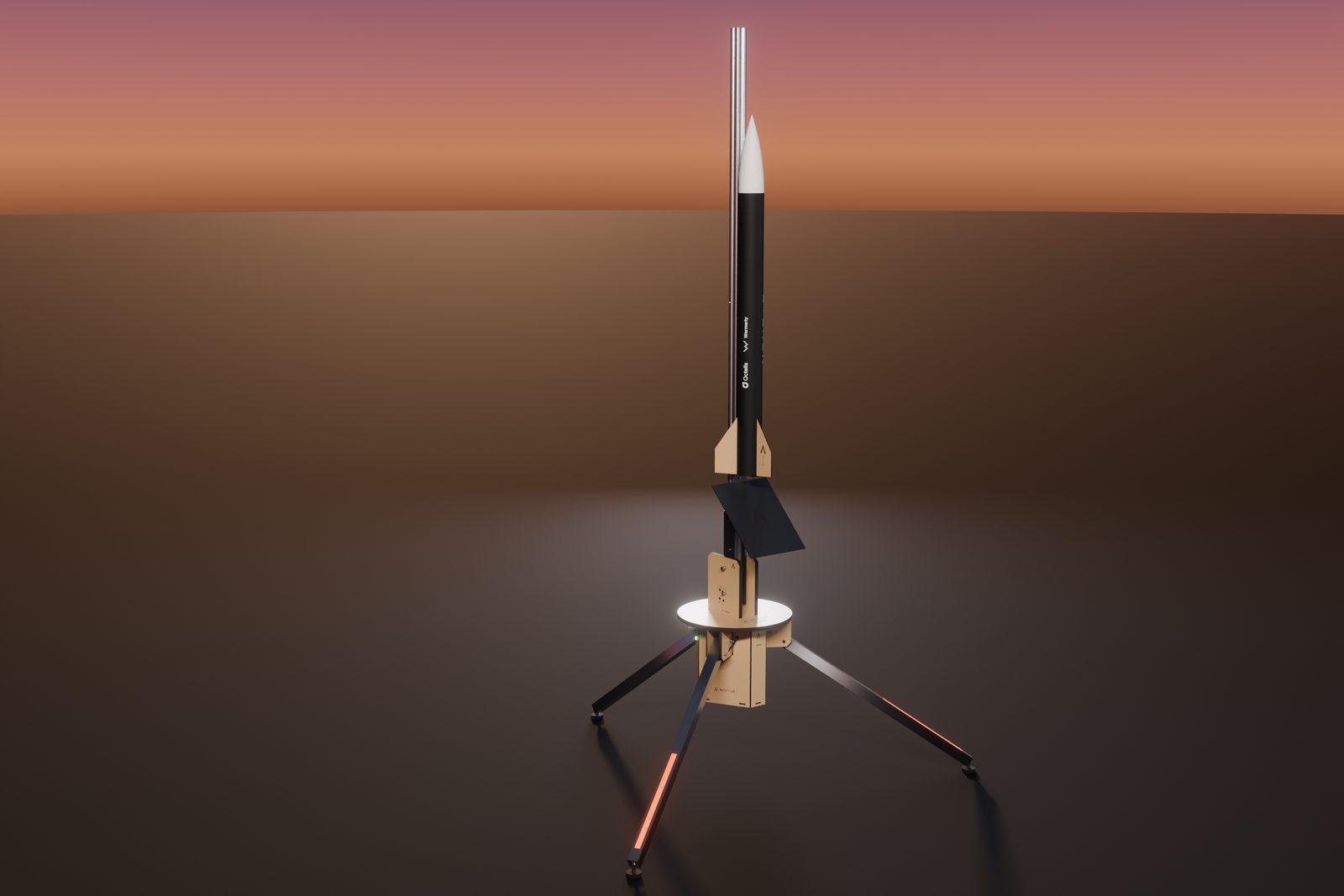
Our launch kit, Harbour, is planned around a folding pad with a 1.2 m rail and an angled steel blast deflector. It is in the planning stage and has not been used at a launch.
How hard the motor must push (section 4.4)
The code says the average thrust of the motor must, at all stages of flight, be more than three times the weight of the rocket as it is propelled. UKRA recommends between 5 and 10 times. A rocket that is too heavy for its motor leaves the rail slowly and may not be stable by the end of it.
A worked example: how fast does Solace leave the rail?
The code gives no exit speed, but you can estimate one. If the motor's thrust stayed constant, the rocket would accelerate at thrust divided by mass, minus gravity, and the speed after travelling a distance L would be sqrt(2 x acceleration x L). For NOVTAR Solace we use the design's estimated 586 g loaded mass and Harbour's planned 1.2 m rail. The rocket's rail buttons sit 25 mm from the tail, so we take about 1.175 m of travel before the last button leaves (assuming the tail starts at the bottom of the rail). The motor is not chosen yet, so this uses the three ratios from the code:
Our arithmetic, not a simulation. It assumes constant average thrust and ignores drag, friction and the motor burning down in mass, so a real motor curve will differ. Mass 586 g is a design estimate. Travel 1.175 m.
Source: UKRA Safety Code 4.4 for the ratios. NOVTAR Solace design file (mass, button position, est.). Harbour planned rail length 1.2 m.
Data table
| Item | m/s |
|---|---|
| 3 times weight (legal minimum) | 6.8 |
| 5 times weight (UKRA low end) | 9.6 |
| 10 times weight (UKRA high end) | 14.4 |
The pattern is simple: the higher the thrust-to-weight ratio, the faster the rocket is moving when it leaves the rail. The code does not explain why it recommends 5 to 10 times rather than the bare 3, but the code does tie the rail length to reaching a stable flight speed. The stability margin matters too, see stability, CG and CP. A real answer needs the motor's thrust curve and a bench or flight check. To read a motor's average thrust, see motor codes explained.
Wind (section 6.2.3)
- Above 10 mph, choose the motor carefully so the rocket is stable before it leaves the rail. The code names weather-cocking, where the rocket turns into the wind.
- Never fly in winds above 20 mph. UKRA recommends not flying above 15 mph.
Fitting it on the rail (section 6.4.2)
The rocket must slide easily along the whole rail. The rail must not be set more than 20 degrees from vertical. The check that the centre of gravity is at least one calibre ahead of the centre of pressure comes before the rocket goes on the rail: see stability.
Questions
What is a launch rail on a model rocket?
It is the rod or rail that guides the rocket along its length, through a launch lug or rail button, until it reaches a stable flight speed. The UKRA Safety Code says it must be rigid, within 20 degrees of vertical for most rockets, and set up with the area clear of flammable material to a radius of three metres.
How long should a launch rail be?
The code gives no length. It says the rail must be long enough for the rocket to reach a stable flight speed before the guide leaves it. Longer rails give more time to speed up.
Can I tilt the rail?
Up to 20 degrees from vertical, except for rockets that gain lift from wings.
What is a rail button?
A small guide on the rocket body that slides in the rail. Solace carries two, 25 mm and about 350 mm from the tail.
Does the thrust-to-weight rule use the motor's peak thrust?
No. The code says average thrust, at all stages of flight.
What is a launch lug, and is it the same as a rail button?
A launch lug is a short tube on the side of a rocket that slides over a launch rod, according to Estes. Rail buttons do the same guiding job on a rail. Our launch lug guide explains the lug.
For the whole launcher, see what a model rocket launcher is.
Next steps
- How to choose the right model rocket motor
- How to read a model rocket thrust curve
- Flying at a UKRA club launch
- Recovery under the UKRA code
- How high will a model rocket go?
- How to build a model rocket in the UK
- NOVTAR safety page
Read the code itself, and follow your club's Range Safety Officer on the day: UKRA Safety Code.