Updated 2026-11-21 · 6 min read
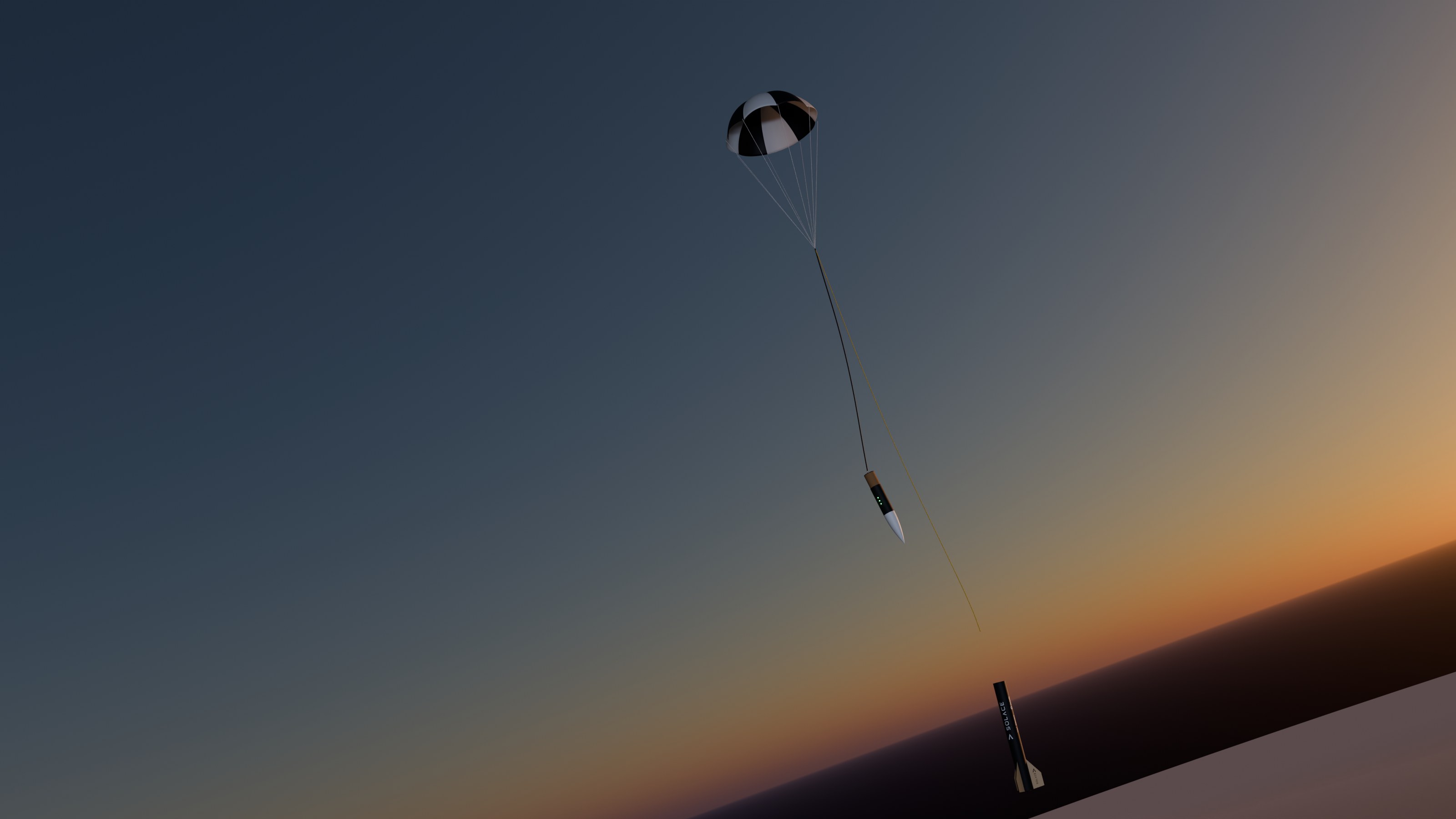
In short: the UKRA Safety Code asks that a rocket is built to return every part safely to the ground so it can be flown again, and that nobody goes to collect it until the descent is completely over. NOVTAR Solace, our first model rocket, is being built to those rules. It has not flown yet.
How fast should it come down, and what size of parachute does that need?
The UKRA code gives no descent speed, so any number here is a design choice. The physics is NASA Glenn's terminal velocity equation: a falling object stops speeding up when drag equals weight, which gives V = sqrt(2 x W / (Cd x air density x area)). A bigger canopy or a higher drag coefficient (Cd) means a slower fall, and a lighter rocket falls slower under the same canopy.
NOVTAR Solace's design file picks a target of 5.5 m/s under the parachute and sizes the canopy for the rocket after the propellant has burnt, which is estimated at 536 g. It assumes a drag coefficient of 0.8 and sea-level air at 1.225 kg per cubic metre. That gives a canopy about 67 cm across. Running the same sum for other sizes shows how much the diameter matters:
Our arithmetic from NASA Glenn's terminal velocity equation. 536 g is the design's estimated burnt-out mass, Cd 0.8 and air density 1.225 kg per cubic metre are the design's assumptions, not measurements. A real canopy needs a drop test.
Source: NASA Glenn terminal velocity page. NOVTAR Solace design file (mass, Cd and target, est.).
Data table
| Canopy diameter (cm) | m/s |
|---|---|
| 40 | 9.24 |
| 50 | 7.39 |
| 60 | 6.16 |
| 67 | 5.52 |
| 80 | 4.62 |
| 100 | 3.7 |
At 5.5 m/s the rocket carries about 8 joules of movement energy when it lands (half the mass times the speed squared: 0.5 x 0.536 x 5.5 x 5.5, our arithmetic). A bigger canopy lands softer but spends longer in the air, so the wind carries it further. That is a trade-off the flier chooses for the field they fly from, which is why the RSO asks whether the rocket can be recovered inside the site.
These numbers are only as good as the assumed Cd. Test the real parachute before relying on it.
Building the recovery system (section 4.5)
The code says rockets must be designed to return all parts safely to the ground so that they may be flown again, with the recovery system protected from the forces and heat of flight. It asks you to pay particular attention to:
- Heat protection. Put thermal insulation, such as wadding, flameproof materials or pistons, between an explosive ejection system and the recovery devices.
- Testing. Ground test any untested ejection system to confirm it works well and safely before flight.
- Assembly. Take care in the assembly, installation and testing of electronic ejection systems. Electronic or mechanical ejection systems must be built so they can be armed and disarmed without moving the rocket.
- The right device for the landing site. For example, floatation devices for water landings and high visibility parachutes or streamers for crop landings.
In NOVTAR Solace the certified motor's own ejection charge puts the parachute out, and the flight computer fires nothing. The design also includes a flame-proof blanket and Kevlar cord, in line with the heat protection point above. To pick the delay for that charge, see motor codes explained.
Before launch: can it be recovered? (section 6.4.4)
The Range Safety Officer (RSO) has the final say on a launch. The code says the RSO should decline approval if they feel the flier has not taken all reasonable steps to ensure the rocket lands and may be recovered within the launch site. Section 5 also asks for a launch site with clear lines of sight to the expected recovery areas, and a clear recovery area both upwind and downwind.
Collecting it (sections 6.5 and the launch rules)
- Do not try to recover the rocket until the descent is fully complete.
- Do not recover rockets that land in dangerous places, or places where you have no permission. Never approach a power line to get a rocket tangled in it.
- Think about footfall and vehicles, and take care of crops, the ground and livestock.
- Only handle a rocket or its parts if you know how it is built. If you do not, leave it untouched and tell the flier or their recovery team where it is.
- If a launch is abandoned, only the flier or someone they name may approach the rocket until all onboard electronics are disarmed, without moving it.
After the flight (section 6.6)
The code asks you to note and understand what happened in the flight, and to look into anything unexpected during flight or recovery. If something went wrong, think about talking it over with the RSO, club representatives or UKRA. This is the reason NOVTAR logs every flight: see how a barometer altimeter works and the flight computer.
Questions
Does the UKRA code set a landing speed?
No. It asks that every part comes back safely so the rocket can be flown again, and leaves the speed to the flier and the RSO.
How do I choose a parachute size for a model rocket?
Pick a descent speed, then use NASA Glenn's terminal velocity equation, V = sqrt(2 x W / (Cd x air density x area)), to find the canopy area. The UKRA code gives no landing speed. For NOVTAR Solace's design file, a 5.5 m/s target at an estimated 536 g gives a canopy about 67 cm across. That is a design estimate, as NOVTAR Solace has not flown.
Does NOVTAR's flight computer deploy the parachute?
No. In NOVTAR Solace the certified motor's own ejection charge puts the parachute out, and nothing on the flight computer fires anything. The flight computer only records the flight.
What if my rocket lands in a tree or on a power line?
Do not climb or approach. The code says nobody may approach a power line to free a rocket, and only people who know how the rocket is built should handle it.
Why are the landing numbers marked as estimates?
Solace has not flown. The mass, the drag coefficient and the 5.5 m/s target are design values that a drop test and a real flight must confirm.
To see drag and descent for yourself, try UKRA's bin bag parachute lesson plan.
For why the parachute needs protecting from the ejection charge, see what is recovery wadding.
Not every model comes down on a parachute; see what a boost glider is.
Next steps
- How far will a model rocket drift in the wind?
- Flying at a UKRA club launch
- How to build a model rocket in the UK
- NOVTAR safety page
Read the code itself before you fly. It is the rulebook, and your club's RSO decides on the day: UKRA Safety Code.