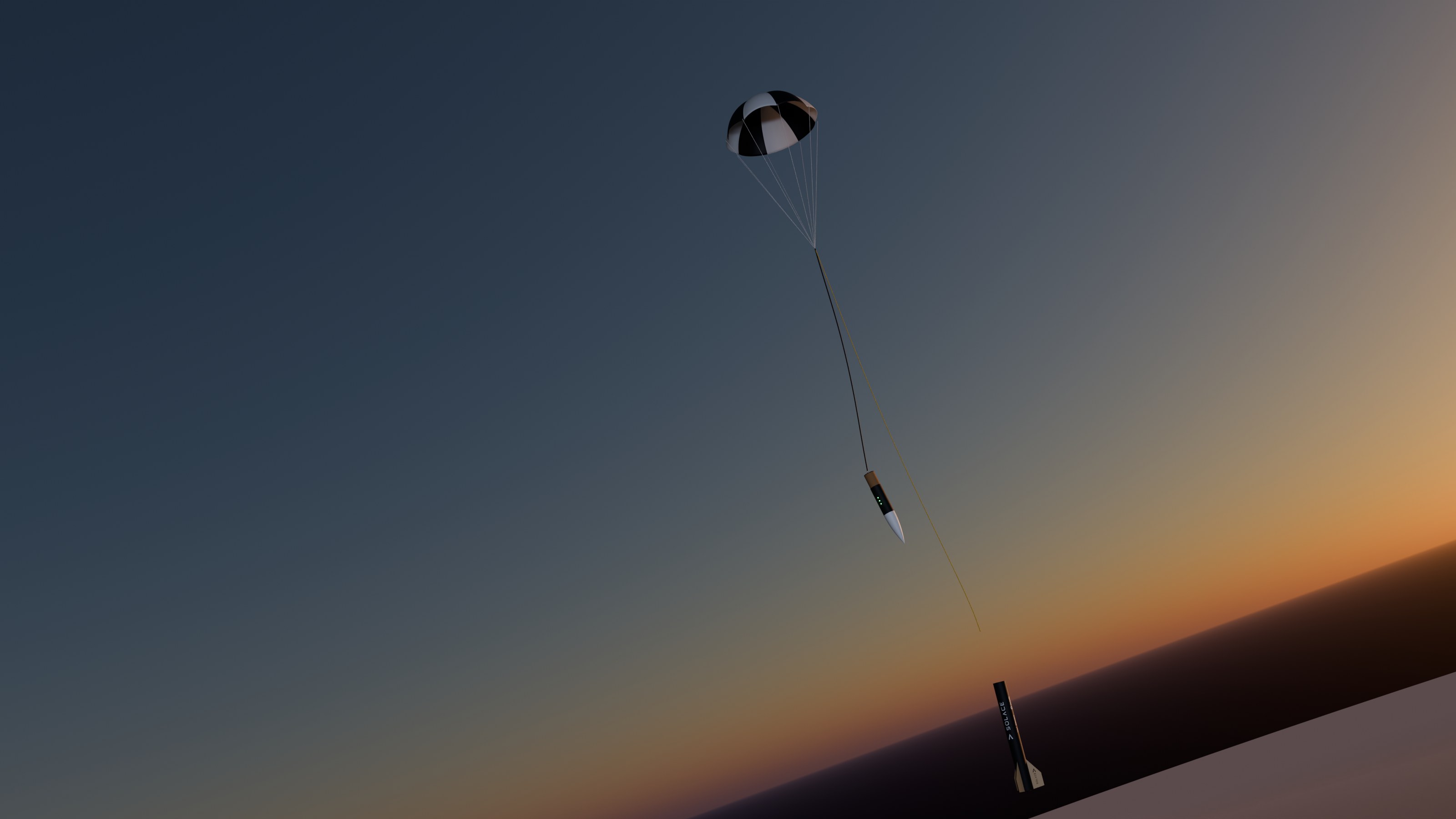
Updated 2026-11-24 · 4 min read
What is the UKRA parachute lesson plan?
It is a one hour activity UKRA published on 12 May 2025 (read 24 November 2026), tagged for its Model Achievement Programme, recovery and construction. The learning objectives are how to build a simple parachute, how parachute size affects descent rate, and the effects of air resistance. It is written for a class, and works for a club night too. For how recovery works on a real rocket, see our recovery guide.
What do you need?
- Heavy duty bin liners
- Cotton thread
- Tape (UKRA says very sticky tape, not weak masking tape)
- Small weights. UKRA used about 35 g fishing weights.
- A second floor or higher window, or a 5 m stick or fishing pole, to launch from
How do you make the parachute?
- Cut the sealed end off a bin bag, shake it open and lay it flat. Cut both folds off to make two pieces, then cut those in half.
- Fold a half side twice and cut the corner off. Where you cut sets the parachute size, so try it a few times first.
- Cut shroud lines from cotton. For a parachute about 60 cm across, UKRA uses lines as long as an adult's arm-span, about 1.75 m.
- Tape the lines to the peaks of the shape. For an octagon you need only four lines, because each runs across the canopy and is attached at both ends, with the weight in the centre.
- Loop the lines over a finger, let the weight hang, and even out the lengths. Tie the lines together in a knot so they stay the same.
- Tie the bundle to the weight.
UKRA notes that polygon shapes are easier than circles because the shroud line positions are easy to find, and that a parachute is generally round and not steerable, unlike a rectangular parafoil.
How do you test it?
The easiest launch is for a colleague to drop or throw it from an upstairs window, with a safe landing zone and allowing for wind drift. Without a high window, UKRA suggests a pole. A spring clothes peg taped to the end of a fishing pole, pinching the canopy centre, lets you raise it and whip the pole back so the parachute releases. Or tape the centre lightly to the pole and flick it free.
What should you compare?
Parachutes of different sizes and build quality will perform differently with the same weight. With even a slight breeze they drift, so compare how big and small ones drift. Our reading: this is the same trade-off as on a rocket, where a bigger canopy lands softer but drifts further, see how far a model rocket drifts.
Is there a bonus activity?
Yes. Tape a small hoop to the opening of a strong bin bag so it stays open, race a short distance, then race again dragging it. UKRA says pupils should feel the drag and run about 1 to 2 seconds slower over 20 m.
Is this a rocket recovery system?
No. It is a classroom demonstration of drag, not a tested recovery system for a rocket. Real rockets follow the UKRA safety code and the maker's guidance. For groups, see our youth groups guide.
What about NOVTAR Solace?
NOVTAR Solace is in build and has not flown. It will fly at a UKRA club launch under a Range Safety Officer.
For shapes and shroud lines, see what shape a model rocket parachute should be.
Next steps
- Read the original UKRA lesson plan.
- Make two sizes and drop both from the same height.
- Note which drifts further in the same breeze.
Questions
How do you make a parachute from a bin bag?
Cut an octagon from a folded bin bag side, tape cotton shroud lines to the peaks, and hang a small weight in the centre. UKRA's lesson plan gives the full method.
How long should the shroud lines be?
For a parachute about 60 cm across, UKRA uses lines about an adult's arm-span long, roughly 1.75 m.
How long does the activity take?
About one hour: around 40 minutes to build and 20 to test.
Does a bigger parachute drift further?
UKRA asks pupils to compare this. Our reading is that a bigger canopy falls slower and so spends longer drifting in any wind.
Has NOVTAR Solace flown?
No. NOVTAR Solace is in build and has not flown.