Updated 2026-11-26 · 11 min read
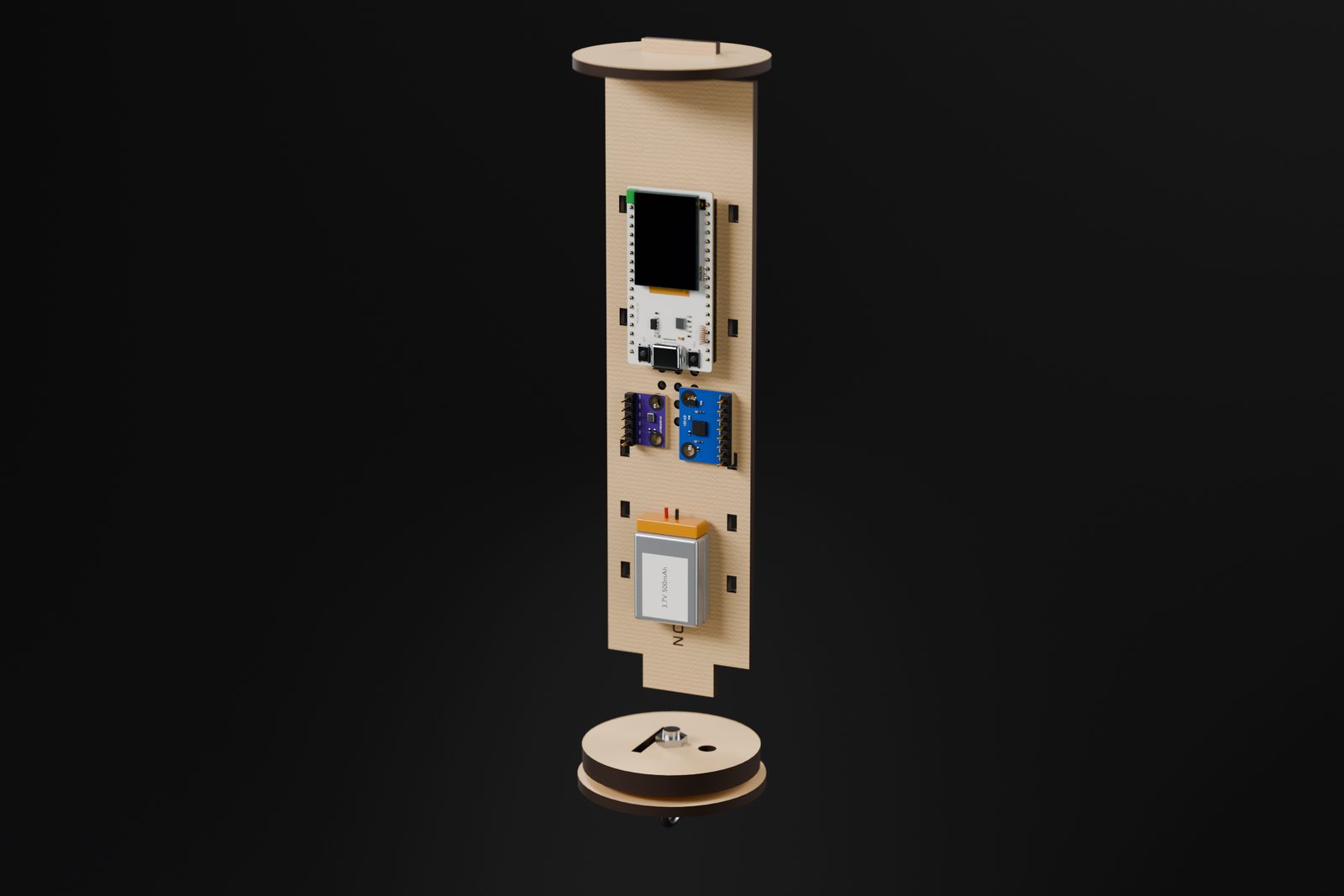
If you want to know how high your rocket went, you have two choices: watch it and do some geometry, or let it measure itself. Most electronic altimeters, including the one in NOVTAR Solace's flight computer, do the second by measuring air pressure. This guide explains how a pressure reading becomes a height, what the Bosch BMP280 sensor's datasheet says about its accuracy and noise, how the filter trades noise against lag, and what our own firmware does. Solace is in build and has not flown, so every figure about it is from the design, the code or a datasheet, never from a flight.
Why pressure tells you height
Air gets thinner as you climb, so the pressure drops. NASA Glenn's atmosphere model gives the curve for the lowest 11 km of the sky as a pair of formulas: the temperature falls by 0.00649 degrees per metre, and the pressure is 101.29 kPa times the temperature (in kelvin, divided by 288.08) raised to the power 5.256. Evaluating that curve for the heights a model rocket reaches gives this:
Our arithmetic: NASA Glenn's metric troposphere curve fit evaluated every 100 m. NASA calls it a teaching model, so real weather moves the numbers day to day.
Source: NASA Glenn Earth Atmosphere Model, metric units.
Data table
| Height (m) | kPa |
|---|---|
| 0 | 101.4 |
| 100 | 100.21 |
| 200 | 99.02 |
| 300 | 97.85 |
| 400 | 96.69 |
| 500 | 95.54 |
| 600 | 94.4 |
| 700 | 93.28 |
| 800 | 92.16 |
| 900 | 91.05 |
| 1000 | 89.96 |
Near the ground the pressure falls by about 12 pascals for every metre, so a climb of 300 m takes about 3.5 kPa off the reading. That is small compared with the roughly 101 kPa you start with, which is why the sensor has to be precise.
Zero on the pad, every time
A barometer does not know the height. It knows the pressure, and the pressure at the pad changes from day to day with the weather. So the altimeter measures the pressure while it is sitting on the pad, takes that as height zero, and reports everything else as height above the pad.
The Bosch datasheet gives two accuracy figures and they answer different questions:
| Figure | Value | Why it matters |
|---|---|---|
| Relative accuracy | ±0.12 hPa, which Bosch says is equal to about ±1 m (700 to 900 hPa, 25 °C) | How well it measures a change in height. This is the useful one in flight. |
| Absolute accuracy | typically ±1 hPa (950 to 1050 hPa, 0 to 40 °C) | How close one reading is to the true pressure. About 8 m by the same conversion, our arithmetic. |
The absolute figure is why you cannot read height from one pressure reading without zeroing first. The relative figure is why zeroed height changes are much better.
Inside the sensor
The sensor on our flight computer is the Bosch BMP280, a pressure and temperature chip about 2.0 by 2.5 mm. Adafruit, who sell it on a small breakout board, describe it as a precision sensor that can be used as an altimeter because pressure changes with altitude. It talks to the processor over a two-wire bus. Two numbers from the datasheet describe how finely it reads:
- Resolution. In its highest-resolution mode it reports pressure in steps of 0.0016 hPa. At our setting (explained below) a step is about 0.66 Pa, which is a bit over 5 cm of height by our arithmetic.
- Noise. The reading jitters a little. Bosch gives the noise as a root mean square value that depends on how many internal readings the chip averages (oversampling) and how hard it filters.
Noise and the filter
The BMP280 has an internal filter that smooths the pressure over several readings. Bosch built it to remove short disturbances such as a door being slammed. The filter has settings of off, 2, 4, 8 and 16. A stronger setting gives less noise, but each reading takes longer to follow a real change.
The setting our firmware uses is highlighted. Multiply by about 8.5 to turn pascals into centimetres of height (1.3 Pa is 11 cm in the datasheet).
Source: Bosch BMP280 datasheet, Table 8, standard resolution row.
Data table
| Item | Pa |
|---|---|
| Filter off | 2.1 |
| Filter 2 | 1.2 |
| Filter 4 | 0.8 |
| Filter 8 | 0.5 |
| Filter 16 | 0.3 |
A stronger filter gives a smoother height but lags a fast climb. At the sensor's roughly 83 readings a second, 5 readings take about 60 ms (our arithmetic).
Source: Bosch BMP280 datasheet, Table 6.
Data table
| Item | Value |
|---|---|
| Filter off | 1 |
| Filter 2 | 2 |
| Filter 4 | 5 |
| Filter 8 | 11 |
| Filter 16 | 22 |
Bosch also gives a recommended set of settings for common uses. The point is how much they differ:
Floor-change detection (highlighted) uses the same oversampling and filter as our flight computer. Fast uses such as drop detection accept more noise in return for a high reading rate.
Source: Bosch BMP280 datasheet, Table 7.
Data table
| Item | cm |
|---|---|
| Indoor navigation | 1.6 |
| Handheld device, dynamic | 2.4 |
| Handheld device, low power | 4 |
| Floor change detection | 6.4 |
| Drop detection | 20.8 |
| Weather monitoring | 26.4 |
What NOVTAR's flight computer does
Everything here comes from the Solace flight computer's code. The sensor is set up with 1 times temperature oversampling, 4 times pressure oversampling and the filter on 4. That is Bosch's standard resolution setting with filter 4, with an estimated noise of 0.8 Pa, about 6.8 cm. The chip is left running in its normal mode, so the sensor's own rate is much faster than the logging rate. Bosch gives about 83 readings a second for this oversampling at the shortest standby time.
- Logging rate. The firmware reads the sensor 10 times a second on the pad and 50 times a second in flight, at 30 bytes a sample, so the log can be replayed afterwards.
- Bad readings are thrown away. A reading outside 50 to 110 kPa is rejected and the last good one is kept, so a glitch cannot become an impossible height.
- Launch and apogee. Launch counts when the acceleration passes 2.5 g for three samples in a row. If the motion sensor is missing, the barometer alone can call launch once the altitude is rising at more than 5 m/s. Apogee counts once the filtered altitude is 2 m below the highest point so far. That is about 30 times the noise figure above, our arithmetic.
- It only measures. The flight computer logs and radios the height down. It fires nothing. The motor's own ejection charge puts the parachute out. See the flight computer page.
Give the sensor a vent hole
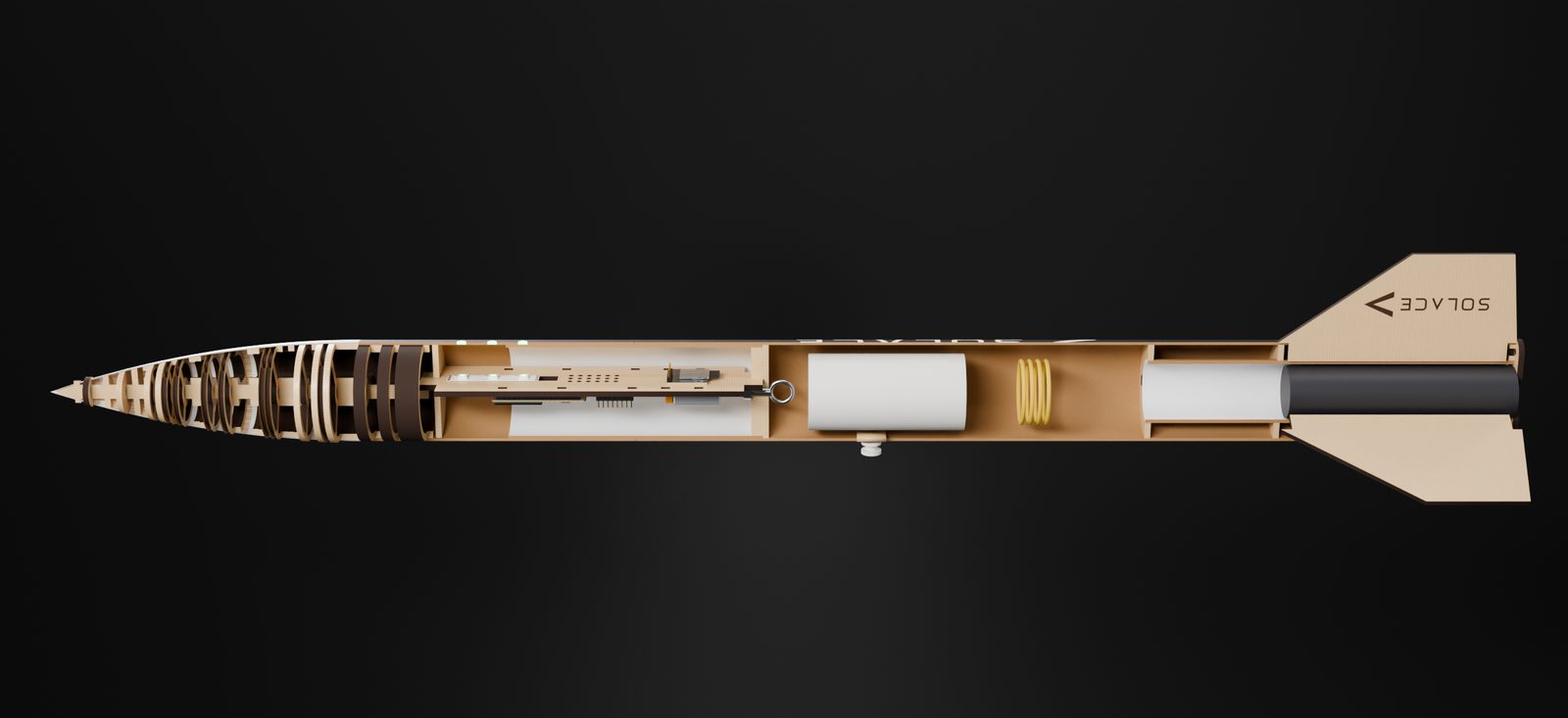
A barometer in a sealed tube only measures the pressure that was in the tube when it was sealed. The Stanford altimeter notes say there must be a vent hole to the altimeter, or it cannot detect changes in pressure. Rocketry for Schools' build guide, quoting Richard Nakka, adds that the bay should have static ports, small holes that let the inside pressure equalise with the outside, and passes on a rule of thumb of one 6 mm hole for every 1,650 cm³ of bay volume. That is a hobby guideline, not a standard, so check it against your own design.
NOVTAR Solace's design has three 2.5 mm vent holes in the payload tube, just below the nose shoulder, marked with a paper template. These are design numbers for a rocket that has not been built yet. We will check the hole size against the volume of the bay and test it on the bench before any flight.
Checking the altimeter yourself
An electronic altimeter is easy to trust and hard to check. NASA Glenn describes a simple way to cross-check a flight by eye. You build an altitude tracker from a printed pattern on card, with a rolled sighting tube, a protractor quadrant, a thread and a small washer. Stand at a measured distance from the pad (NASA uses 30 m), keep the tube pointed at the rocket's highest point, and read the angle the thread makes. Simple trigonometry turns the angle into the height. NASA points out the limit of the method: it assumes the rocket goes straight up. If it flies towards you the answer comes out too high, and if it flies away it comes out too low, and using two or three stations and averaging helps. Add the height of the person holding the tracker.
Practise first on a known object. NASA suggests a building or a flagpole. Then compare the tracker with the altimeter after a flight. A disagreement of a few metres is normal. A disagreement of tens of metres means something is wrong with the vent, the zeroing or the filter.
What the altimeter cannot do
- It reads height, not speed or position. Speed has to be worked out from the height over time, which is why filter lag matters.
- It reads the pressure at the sensor. Anything that changes the pressure in the bay, such as a closed bay or the pressure wave from an ejection charge, can fool it.
- It is only as good as its setting. A heavy filter reads smoothly but lags. A light filter follows fast but is noisy. There is no setting that is best for everything.
- Measure-only flight computers like ours do not control anything. If a reading looks wrong, the log is for learning from, and the Range Safety Officer's rules at a club launch still apply.
Questions
How does a model rocket altimeter work?
It measures air pressure with a small barometer. The pressure falls as the rocket climbs, so the altimeter records the pressure on the pad as height zero, then turns each lower reading into a height above the pad using a formula for how pressure changes with height.
How accurate is a barometric altimeter?
For the Bosch BMP280 the datasheet gives a relative accuracy of about ±1 m for measuring a change in height, and an absolute accuracy of about ±1 hPa, roughly 8 m, which is why the altimeter must be zeroed on the pad. Filtering reduces the noise to a few centimetres at the cost of some lag.
Does an altimeter need a vent hole?
Yes. The sensor can only read the pressure it can reach, so the bay needs small static holes to the outside. The Stanford student rocketry notes say there must be a vent hole, and a hobby guideline is one 6 mm hole for every 1,650 cm³ of bay volume.
How do you check an altimeter without electronics?
NASA Glenn's altitude tracker uses a protractor and trigonometry: measure the angle to the rocket at its highest point from a known distance and work out the height. It is accurate only if the rocket flies straight up, and averaging two or three stations improves it.
Can I use a home-made altimeter for a UKRA certification flight?
No. UKRA's FCO Guidelines say the altimeter or deployment device must be commercially available, and that homebrew altimeters are not permitted for certification flights. See what UKRA assessors check.
Does the NOVTAR flight computer fire the parachute?
No. It only measures, logs and sends the height to the ground. The motor's own ejection charge puts out the parachute, and NOVTAR Solace has not flown yet.
Without an altimeter you can still estimate height with two observers and a scale drawing.
Other things a rocket can carry are listed in what a model rocket can carry as a payload.
Where to go next
- How to work out rocket speed and acceleration
- Model rocket accelerometer range: what to set
- Why a model rocket flies lower than the simulation says
- UKRA altitude records: how to claim one
- How air temperature and pressure change with height
- Rocket flight computer vs altimeter vs data logger
- How a model rocket flight computer works
- Lodestar Dev, the hand-wired starting point
- LoRa telemetry for a model rocket
- Model rocket recovery under the UKRA code
- Model rocket motor codes explained
- How high will a model rocket go?
- Model rocket avionics bay
- What is air pressure? Why it matters for rockets
Sources
- https://www.bosch-sensortec.com/media/boschsensortec/downloads/datasheets/bst-bmp280-ds001.pdf
- https://www.grc.nasa.gov/www/k-12/airplane/atmosmet.html
- https://www.grc.nasa.gov/www/k-12/rocket/TRCRocket/altitude_tracking2.html
- https://ssi-wiki.stanford.edu/Altimeters
- https://rocketryforschools.co.uk/blogs/rocketry-guides/diy-rocket-altimeter-step-by-step-guide
- https://learn.adafruit.com/adafruit-bmp280-barometric-pressure-plus-temperature-sensor-breakout/overview