Updated 2026-11-22 · 5 min read
In short: an avionics bay is the section of a model rocket that carries the electronics: flight computer or altimeter, sensors, battery and a switch. It needs a rigid sled to hold the parts, a way to turn it on without opening the rocket, and small vent holes so a barometer can feel the outside air pressure. NOVTAR Solace's bay has all three, and NOVTAR Solace has not flown yet.
What does an avionics bay do?
It keeps the electronics in one place, held firm through launch, with the air pressure outside the rocket reaching the pressure sensor. The bay sits between the nose and the parachute, so it also has to take the pull of the recovery cord when the parachute opens.
A bay is built from a few parts:
- A coupler or bay tube that fits inside the body tube.
- Bulkheads, solid discs at each end that close the bay and give the recovery cord something to pull on.
- A sled, a flat board that holds the electronics. Zip ties, standoffs or screws fix the parts to it.
- A switch reachable from outside.
- Vent holes for the barometer.
How is the NOVTAR Solace bay laid out?
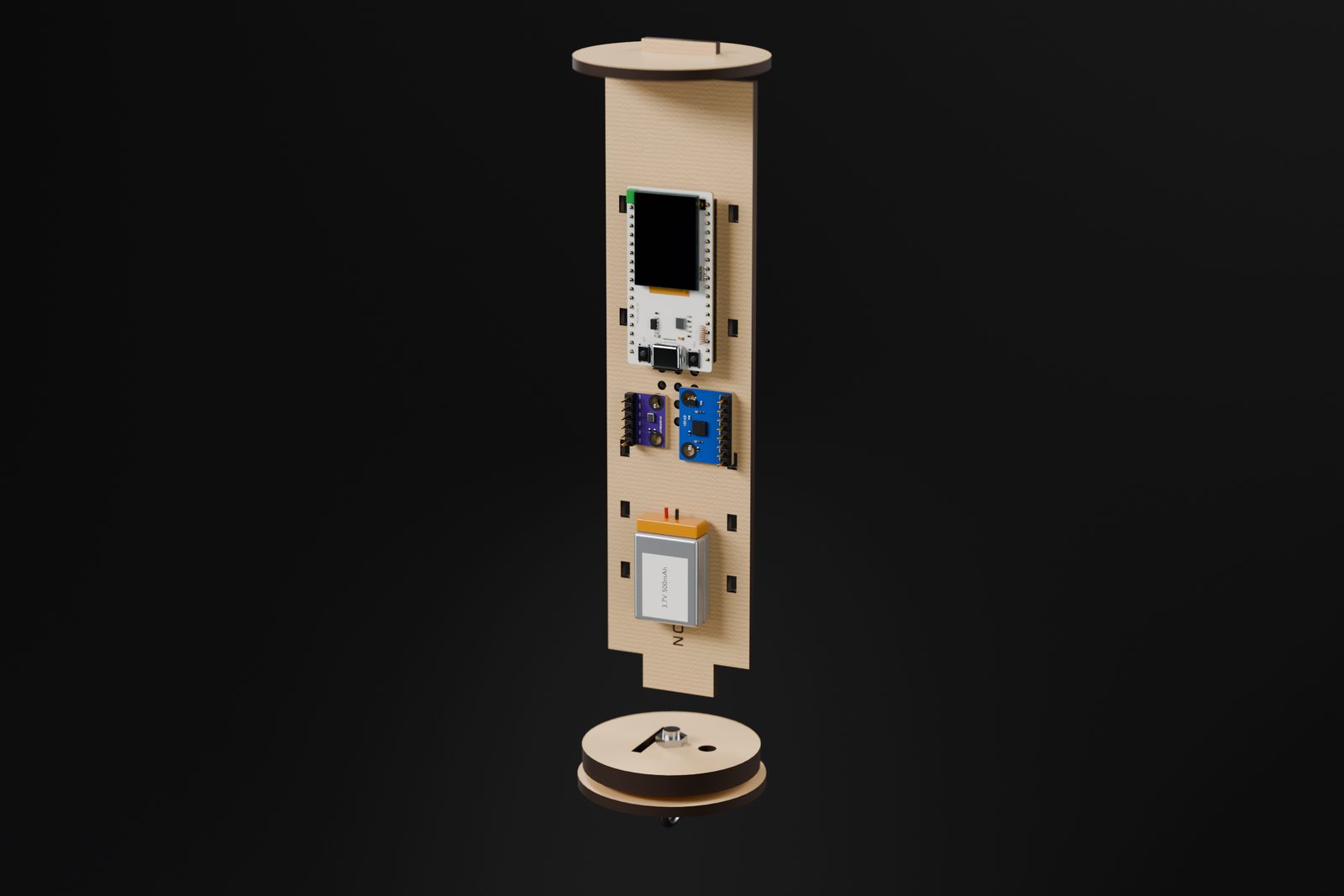
NOVTAR Solace's public build book describes a sled about 167 mm long, cut from 3.2 mm plywood. The Heltec V3 board sits on M2.5 standoffs in a hole field. The sensors and a 1S LiPo battery (400 to 600 mAh) are held with zip ties through slots, and the wires go through a pass-through. A microSD module sits on the back face, and three status LEDs show through small windows in the tube. A small slide switch turns it all on.
The bottom of the bay is sealed by a 9 mm plywood bulkhead with an M5 eye bolt for the shock cord, and the sled's bottom tab goes into a slot in that bulkhead. The top tab goes into a sled cap, and the nose cone's hollow shoulder holds everything down. All of this is a design for a rocket that is in build.
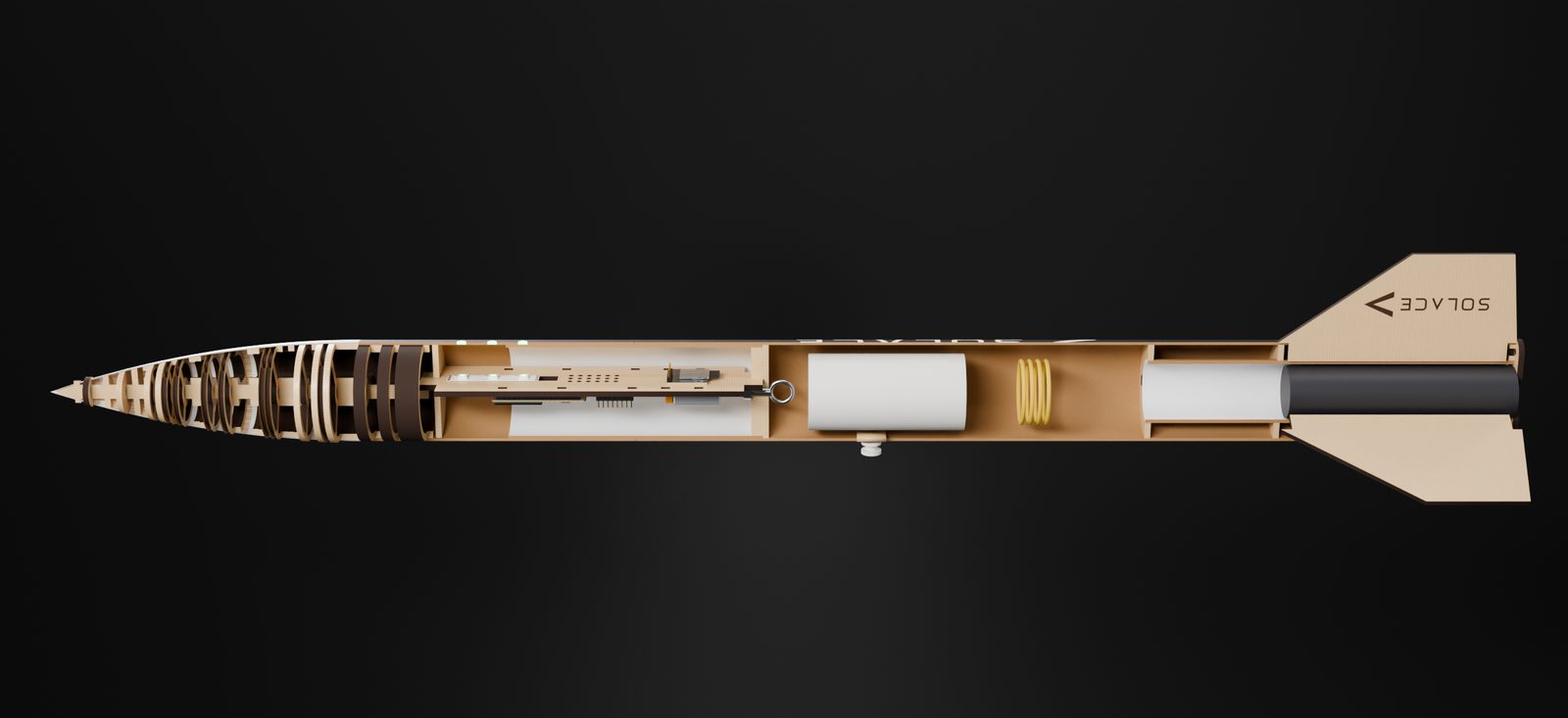
The estimated mass of everything in the bay is 88 g in the design: board, sensors, battery, microSD module, sled, bulkheads and eye bolt (a design estimate, not a weighed figure). The stability guide shows where that sits in the rocket's balance.
Why does a barometer need vent holes?
A barometer in a sealed tube only measures the pressure that was in the tube when it was sealed. The Stanford altimeter notes say there must be a vent hole to the altimeter, or it cannot detect changes in pressure. Rocketry for Schools' guide, quoting Richard Nakka, says the bay should have static ports, small holes that let the inside pressure equalise with the outside, and passes on a rule of thumb of one 6 mm hole for every 1,650 cubic centimetres of bay volume. That is a hobby guideline, not a standard.
A worked vent-hole check for NOVTAR Solace
NOVTAR Solace's design has three 2.5 mm vent holes just below the nose shoulder. Here is our arithmetic against the rule of thumb:
- The payload tube section is about 54 mm across inside and 150 mm long, which is about 344 cubic centimetres if empty. That overstates the air volume, because the sled and parts take up room.
- The rule of thumb scales one 6 mm hole's area (28.3 square millimetres) by volume. For 344 cubic centimetres that is about 5.9 square millimetres, roughly one 2.7 mm hole.
- Three 2.5 mm holes add up to about 14.7 square millimetres, about 2.5 times the rule of thumb.
Our arithmetic. The rule of thumb is a hobby guideline quoted by Rocketry for Schools (one 6 mm hole per 1,650 cubic centimetres). The volume is the payload tube section ignoring the parts inside, so the real figure is smaller. The design is not built or tested.
Source: Rocketry for Schools (quoting Richard Nakka). NOVTAR Solace design file (hole size and tube size, est.).
Data table
| Item | mm2 |
|---|---|
| Rule of thumb for 344 cm3 | 5.9 |
| Design: three 2.5 mm holes | 14.7 |
More vent area than the rule says is not automatically better, because bigger holes let in more disturbed air in flight, and we have not measured that. We plan to bench-test the bay before any flight. Our altimeter guide explains how the sensor turns pressure into height.
How do you switch it on without opening the rocket?
The UKRA Safety Code says electronic or mechanical ejection or air-start systems must be built so they can be armed and disarmed without changing the rocket's orientation or position. NOVTAR Solace's flight computer fires nothing, so that rule does not apply to its electronics, but the idea is the same: use an outside-reachable switch and check the status at the pad. In NOVTAR Solace's design the slide switch lines up with an 8 mm access hole, and three LEDs show whether the sensors, the logging card and the radio are ready. They only show what the computer already knows. Mission Control's GO or NO-GO is still the one that counts.
Questions
What is an avionics bay in a model rocket?
The section that carries the electronics: flight computer or altimeter, sensors, battery and a switch, held on a sled between two bulkheads.
Does an altimeter bay need vent holes?
Yes for a barometer. A sealed bay cannot follow outside air pressure. Hobby guidance is one 6 mm hole for every 1,650 cubic centimetres of bay volume, which is a rule of thumb, not a standard.
What is a sled?
A flat board, in NOVTAR Solace's case 3.2 mm plywood about 167 mm long, that the electronics are fixed to. It slides into the bay tube between the bulkheads.
Does NOVTAR Solace's flight computer fire anything?
No. The motor's own ejection charge puts out the parachute, and the flight computer only records and sends data.
Has this bay flown?
No. NOVTAR Solace is in build and has not flown. The sizes and numbers here are design values.
Next steps
- Model rocket altimeter and barometer guide
- NOVTAR flight computer
- Model rocket recovery under the UKRA code
- UKRA rules for rocket electronics, TVC and GPS
- How many g does a model rocket pull?
Read the code itself before you fly: UKRA Safety Code. Your club's RSO decides on the day.