Updated 2026-11-25 · 11 min read
A model rocket flight can be over in under a minute, and the rocket may land somewhere you cannot see. A radio link gives you the height, speed and status while it happens, and tells you the rocket is alive after it lands. This guide explains how LoRa works, why we chose the settings we did, what is in each packet, and how long it takes on the air, worked out step by step. NOVTAR Solace is our first model rocket. It is in build and has not flown, so every number about the link is a design choice or our own arithmetic, not a range test.
What is LoRa?
Semtech, the company that makes LoRa chips, describes LoRa (short for long range) as a spread spectrum modulation technique derived from chirp spread spectrum. It is built for long range and low power. LoRa is the radio layer. LoRaWAN is a separate standard, managed by the LoRa Alliance, that connects devices to networks, and Semtech notes that some users run the LoRa radio layer on its own with their own network on top. A rocket link needs no network, so NOVTAR uses the radio layer directly between two boards.
The hardware on both ends
The Heltec WiFi LoRa 32 V3. Heltec's documentation describes it as an ESP32-S3 with an SX1262 LoRa chip, Wi-Fi, Bluetooth, a battery charger and a 0.96 inch OLED screen, and lists its LoRa transmit power as 21 dBm, give or take 1. The same board sits on the rocket and in the ground station, so both ends can share one settings file. NOVTAR sets the power to 14 dBm, well under the board's maximum.
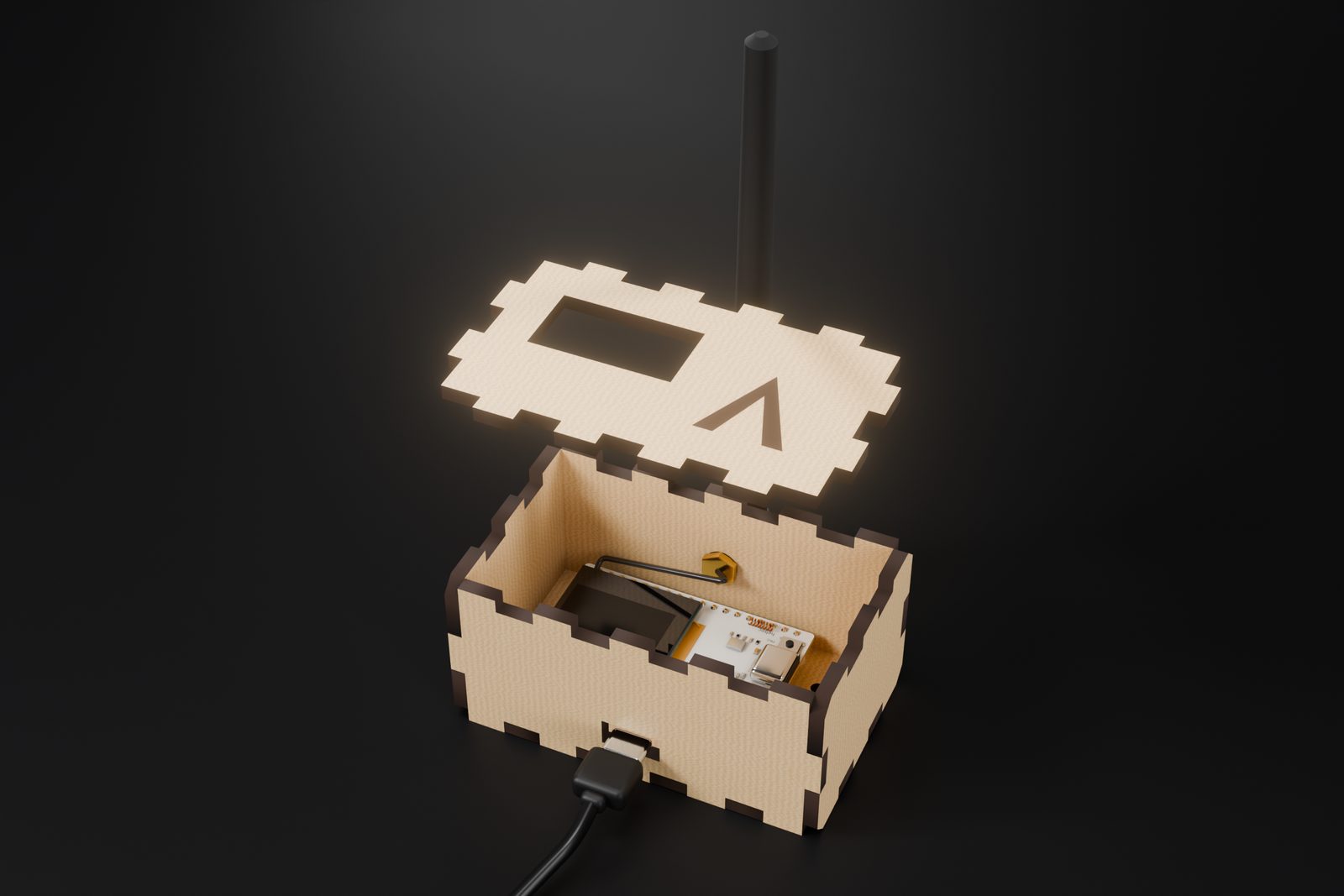
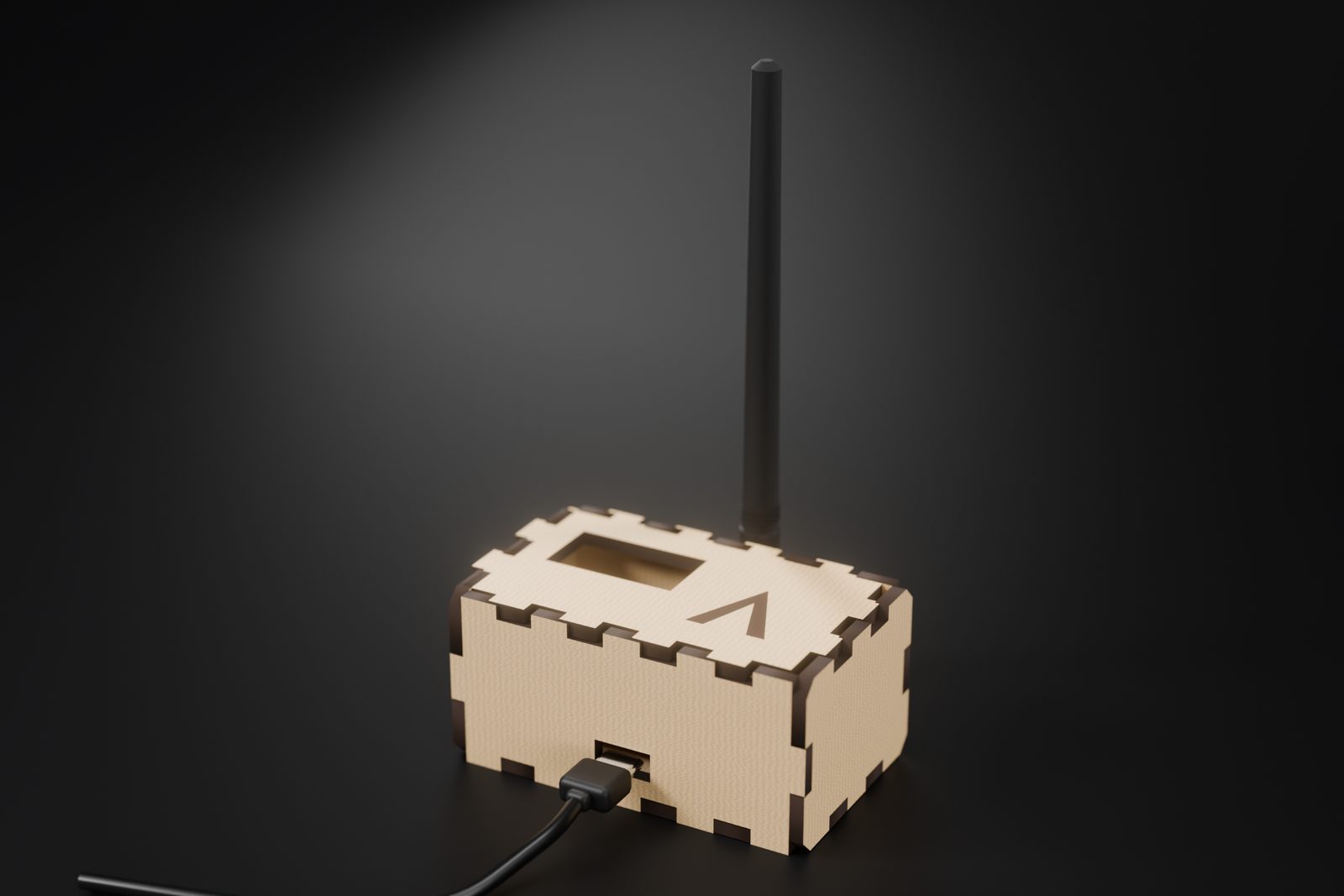
See Beacon, the ground station, and Lodestar, the flight computer family.
The three settings
Three settings decide how far the signal goes and how long each packet takes. They pull range against speed:
| Setting | What it does | NOVTAR's choice |
|---|---|---|
| Spreading factor (SF) | A higher number is slower, so it is easier to receive from further away | 7 |
| Bandwidth | A wider channel carries data faster but is less sensitive | 250 kHz |
| Coding rate | Extra bits that let the receiver fix some errors | 4/5 |
The slow settings reach further and the fast ones carry more. A model rocket stays near the pad, so we picked the fast end. That keeps each packet short, which is the next thing to work out.
How long does a packet take on the air?
Time on air is not guesswork. It follows a formula from Semtech's documentation, and an open-source calculator that implements it has been checked against real signals captured with a software-defined radio. We have not been able to read Semtech's own PDF from our server, so we checked our version of the formula against one of that calculator's published test cases (11 bytes, coding rate 4/8, explicit header and checksum, 40 payload symbols), and it matches. Here is the sum for our packet. These are our own figures.
- Symbol time. 2 to the power of SF, divided by the bandwidth. At SF7 and 250 kHz that is 128 / 250,000 = 0.512 ms.
- Preamble. A fixed lead-in of 8 symbols plus 4.25 = 12.25 symbols.
- Payload. For 25 bytes, with the usual header and checksum, coding rate 4/5, the formula gives 48 symbols.
- Total. 60.25 symbols x 0.512 ms is about 30.8 ms.
So one packet takes about 31 ms on the air. The note in our firmware header says about 25 ms and our flight computer page says about 25 ms and 5 per cent duty. The formula with a standard 8-symbol preamble gives about 31 ms and 6 per cent. Both are inside a 10 per cent limit, but we will correct the figures where they are wrong once the real radio is on the bench and we can time a packet.
Our arithmetic with the standard LoRa time-on-air formula: 8-symbol preamble, explicit header, checksum on, coding rate 4/5. Real radios and settings can differ a little.
Source: Formula from Semtech's LoRa documentation as implemented in an open-source calculator (github.com/ifTNT/lora-air-time), checked by us against one of its published test cases.
Data table
| Item | ms |
|---|---|
| SF7 | 30.8 |
| SF8 | 56.6 |
| SF9 | 102.9 |
| SF10 | 205.8 |
| SF11 | 370.7 |
| SF12 | 741.4 |
Each step up in spreading factor roughly doubles the time on air. That is the price of range, and it matters because of the rule on the next line.
Why the duty cycle matters
In the UK licence-free band around 869.4 to 869.65 MHz the rule NOVTAR's firmware notes quote is a 10 per cent duty cycle: a transmitter may be on the air for no more than 10 per cent of the time. The note names Ofcom's short range device rules, IR 2030. We have since read the March 2023 version of IR 2030, and it lists 869.40 to 869.65 MHz at 500 mW e.r.p. with a duty cycle of 10 per cent or less (see our radio rules guide). Ofcom may have changed it since, so check Ofcom yourself before you build a link or change a radio setting, because the limits are legal ones.
Sending twice a second, here is the share of the time the radio would be on the air at each spreading factor:
Our arithmetic from the airtime chart above. A 10 per cent duty limit, as quoted in our firmware notes, is passed from SF8 upwards at this packet rate. Check Ofcom IR 2030 for the real limit.
Source: Time-on-air figures worked out above; the duty cycle limit is quoted from NOVTAR's firmware notes, not read from Ofcom.
Data table
| Item | % |
|---|---|
| SF7 | 6.2 |
| SF8 | 11.3 |
| SF9 | 20.6 |
| SF10 | 41.2 |
| SF11 | 74.1 |
| SF12 | 148.3 |
That is why NOVTAR uses SF7. A slower setting would either need fewer packets a second or break the limit. Fewer packets a second is the other way to get range, at the cost of a coarser picture of the flight.
What is in each packet
Every packet is 25 bytes. The rocket and the ground station use one shared header file for the layout, so the two ends cannot drift apart.
Fields in the order they are sent. Height is in decimetres, speed in centimetres per second.
Source: NOVTAR n1_radio.h (the packet structure).
Data table
| Item | bytes |
|---|---|
| Magic letters N, 1 | 2 |
| Packet number | 2 |
| Time since power on | 4 |
| Flight phase | 1 |
| Height above the pad | 4 |
| Vertical speed | 2 |
| Highest point so far | 4 |
| Total acceleration | 2 |
| Battery voltage | 2 |
| Status flags | 1 |
| Last command received | 1 |
The phase is one of pad, boost, coast, descent or landed. The status flags say whether the barometer, the motion sensor and the logging are working, whether the flash memory is nearly full (a no-go), and whether the microSD card is fitted and being written. The packet does not carry a GPS position. See how the height is measured.
NOVTAR also sets a sync word, 0x4E, the letter N, so the receiver ignores other LoRa users' packets. A sync word is a courtesy filter, not security: do not treat it as a way to keep a link private.
Can the ground talk back?
Only a little. The ground station can send two harmless commands: PING, to check the link, and LOCATE, which sounds the buzzer and lights to help find the rocket. The rocket acts on them only on the pad or after landing, and it confirms the last one in its next packet. There is no command that arms, ignites, steers or releases anything. Nothing on the flight computer fires anything, and the motor's own ejection charge puts the parachute out. Read more on the safety page.
What you see on the ground
The ground station passes each packet to the laptop over USB. Mission Control shows the height, phase and checks live and keeps a log of every flight. Its demo mode runs on simulated data, and the screens in it are labelled as simulation, not flight. The board on the rocket also logs the flight to its own flash and to a microSD card, so the radio is for watching live. It is never the only copy of the data.
What we have not done yet
NOVTAR Solace has not flown, and we have not measured the range of the link with the rocket in the air. We have not timed a packet on the bench with the real board, so the 31 ms is arithmetic. When we have results, they will go in the journal with the conditions. Until then, treat range as unknown. Semtech describes LoRa as long range, but actual range depends on the settings, the antenna, the terrain and what is around.
A short checklist for your own link
- Use the same frequency, spreading factor, bandwidth, coding rate and sync word on both ends.
- Keep packets small and send only what you need.
- Work out the time on air, then the share of time the radio is on, and check it against the limit for your band.
- Check the UK rules with Ofcom before you transmit, and keep the power modest.
- Put the antenna where it can see the sky, and test the link on the ground before any flight.
- Log on the rocket as well. A radio link drops out. A log on board does not.
- Fly at a UKRA club launch, with the Range Safety Officer's agreement for anything electronic you add.
Questions
What is LoRa telemetry for a model rocket?
It is a way to send the rocket's height, speed and status to the ground by radio using LoRa, a long-range, low-power method from Semtech. A small board on the rocket sends short packets and a matching receiver on the ground passes them to a laptop.
What frequency does LoRa use in the UK?
NOVTAR's design uses 869.525 MHz, in the licence-free band 869.40 to 869.65 MHz, which our firmware notes say has a 10 per cent duty cycle limit. The rules are set by Ofcom (IR 2030), and we have read the March 2023 version of IR 2030, which agrees. Check Ofcom's current version before you transmit.
How long does a LoRa packet take to send?
It depends on the settings and the size. At spreading factor 7 and 250 kHz, a 25-byte packet takes about 31 ms by our arithmetic. At spreading factor 12 the same packet would take about 740 ms.
How far can LoRa telemetry reach from a rocket?
We do not know yet for NOVTAR, because Solace has not flown and we have not measured it. Semtech describes LoRa as a long range technique, and the real range depends on the settings, the antennas, the terrain and obstacles.
Do I need a licence to use LoRa on a model rocket in the UK?
UKRA says to follow the law on frequency, power and duty cycle and to ask Ofcom if you are unsure. Ofcom's IR 2030 covers licence exempt short range devices such as the 869.40 to 869.65 MHz band. Our rocket tracker radio rules guide sets out what we read, from the March 2023 version, so check the current one.
What is the difference between LoRa and LoRaWAN?
Semtech says LoRa is the radio technology (the silicon it developed) and LoRaWAN is an interoperability standard managed by the LoRa Alliance. It adds that some customers use the LoRa radio layer with their own network on top. NOVTAR's link is a direct point to point radio link between a board on the rocket and a ground receiver, not a LoRaWAN network.
Can the ground station control the rocket?
Not in any way that matters for safety. NOVTAR's link has two commands, PING and LOCATE, and the rocket acts on them only on the pad or after landing. Nothing on the flight computer fires or arms anything.