Updated 2026-11-22 · 5 min read
What are the parts of a model rocket?
NASA Glenn's Beginners Guide to Aeronautics (page last updated 7 July 2025, read 22 November 2026) cuts a hole in a single-stage rocket's body tube and names what is inside. In plain words:
- Body tube: the main cardboard tube everything attaches to.
- Fins: plastic or balsa wood at the rear. NASA says they give stability in flight.
- Motor (engine): a small, pre-packaged solid-fuel motor, used once and then replaced. See our motor code guide.
- Motor mount (engine mount): passes the motor's thrust into the rocket. NASA describes it as heavy cardboard or wood, with a hole so the ejection charge can pressurise the body tube.
- Recovery wadding: goes between the motor mount and the recovery system so the hot gas does not damage it.
- Recovery system: a parachute or streamer made of thin plastic, with lines to connect it to the nose cone.
- Nose cone: balsa or plastic, solid or hollow, pushed into the body tube.
- Shock cord: an elastic cord joined to both the body tube and the nose cone, which keeps all the parts together on the way down.
- Launch lugs: small tubes (straws) on the body tube that the launch rail passes through.
What does recovery mean on a model rocket?
Recovery is how the rocket comes back down slowly enough to be flown again. On a basic model rocket the recovery system is a parachute or streamer, joined to the nose cone and body by a shock cord, and the motor's ejection charge pushes it out at the top of the flight. Recovery wadding sits between the motor mount and the recovery system to protect it from hot gas.
How does it work together?
The motor pushes. Its thrust goes through the motor mount into the body. The fins keep it pointing the right way. At the top, the motor's ejection charge blows the nose off and the parachute comes out. The shock cord stops the pieces drifting apart. Our stability guide explains why the fins matter, and our recovery guide covers the descent.
How does NOVTAR Solace's design map onto that?
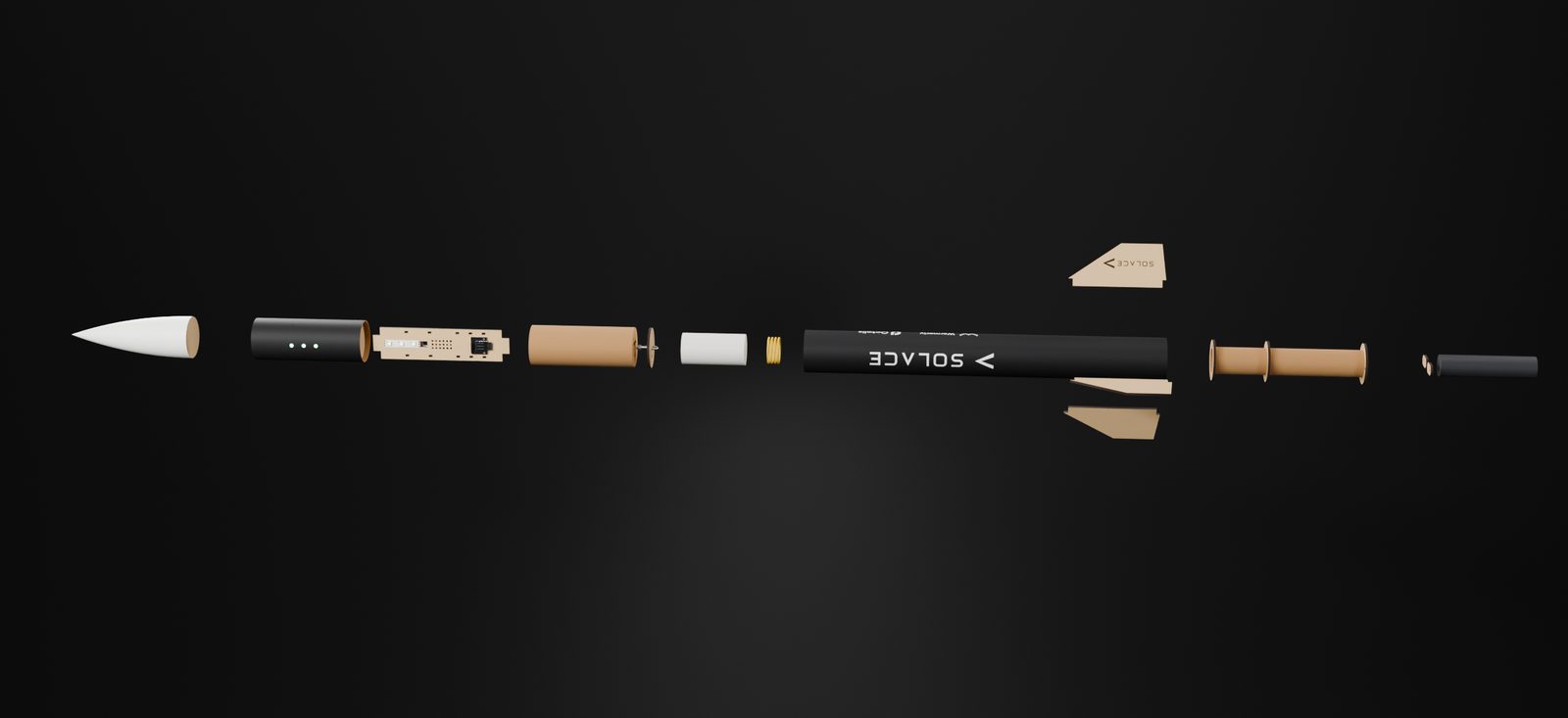
From NOVTAR Solace's public build book, as a design for a rocket in build:
| Basic part | In NOVTAR Solace's design |
|---|---|
| Nose cone | A stack of laser-cut plywood rings on a dowel, sanded to shape, 170 mm long |
| Body tube | Cardboard tubes about 57 mm across: a 150 mm payload tube and a 480 mm booster tube |
| Fins | Three plywood fins through slots, epoxied to the motor tube |
| Motor mount | A 29 mm tube with three centring rings and motor clips |
| Recovery | The motor's own ejection charge puts out the parachute |
| Guides | Rail buttons, not launch lugs |
Where it differs from the basic list is the payload tube, which holds the avionics bay: a sled, bulkheads and the flight computer. See the avionics bay guide. The flight computer fires nothing.
What does the UKRA code ask of the parts?
Our reading of the UKRA Safety Code (read 22 November 2026): materials and joints suited to the forces of flight, no unnecessary metal parts, no sharp edges on nose cones or fins, and a recovery system protected from the heat of ejection. The how to build guide goes through it. It is not UKRA's advice, and your club's Range Safety Officer decides on the day.
Questions
What are the main parts of a model rocket?
Nose cone, body tube, fins, motor mount with the motor, a parachute or streamer on a shock cord, and launch lugs or rail buttons.
What does recovery mean in model rocketry?
It is how the rocket returns slowly enough to be flown again. On a basic model rocket that means a parachute or streamer pushed out by the motor's ejection charge at the top of the flight.
What does the shock cord do?
It joins the nose cone to the body tube, so all the parts stay together when the parachute opens.
How does the recovery system of a model rocket work?
The motor's own ejection charge blows the nose off at the top of the flight and pushes the parachute or streamer out. The shock cord keeps the nose cone and body tube joined, and recovery wadding between the motor mount and the parachute protects it from the hot gas. See the recovery guide.
What parts does a rocket have, as NASA Glenn lists them?
NASA Glenn's labelled diagram of a model rocket shows the nose cone, body tube, fins, motor mount with the motor, a recovery system on a shock cord, and launch lugs. For a full-size rocket NASA groups the parts into four systems instead: see the four main systems of a rocket.
What is a motor mount?
The part that holds the motor and passes its thrust into the rocket. It has a hole so the ejection charge can pressurise the body tube.
What are launch lugs?
Small tubes glued to the body tube that slide over the launch rod or rail and keep the rocket pointed the right way until the fins can steer, according to Estes. See what a launch lug is. Some rockets use rail buttons instead, as NOVTAR Solace's design does.
Has NOVTAR Solace flown?
No. NOVTAR Solace is in build and has not flown.
A short tube on the body, the launch lug, guides the rocket on the launch rod. See what a launch lug is.
A payload section can carry a camera, sensor or egg; see what a model rocket can carry as a payload.
For recovery faults and fixes, see why a model rocket parachute does not open.
For what each part is made from, see what materials model rockets are made from.
Next steps
- How to cut a model rocket body tube neatly
- How to attach a shock cord to a model rocket
- Design a model rocket in OpenRocket: the components
- How to build a model rocket in the UK
- Model rocket stability: CG, CP and the margin
- What happens in a model rocket flight, step by step
- What are the four main systems of a rocket?
- NOVTAR Solace
Read the code before you fly: UKRA Safety Code. Your club's RSO decides on the day.