Updated 2026-11-21 · 8 min read
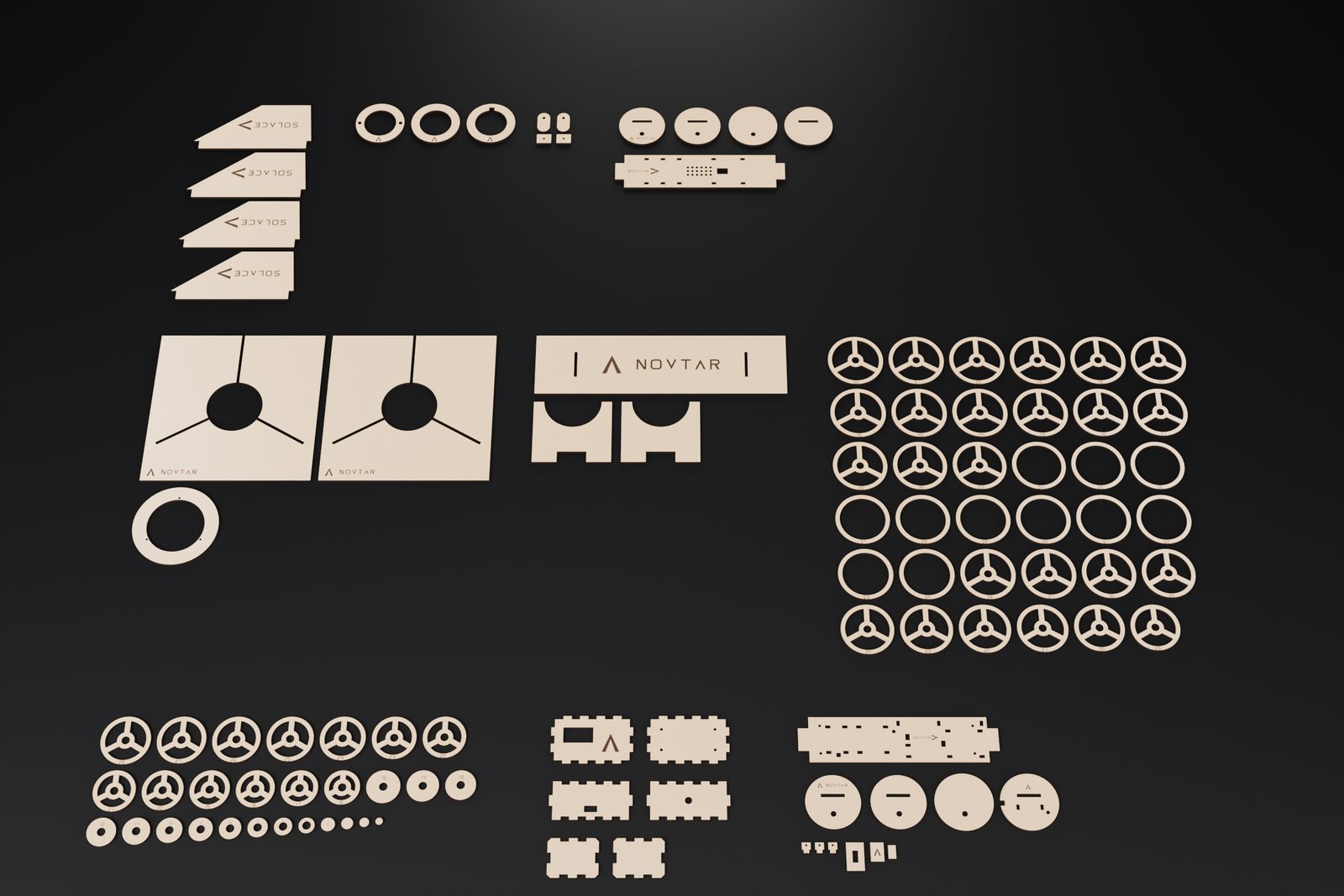
Laser-cut plywood fins are the part of a model rocket where a laser earns its keep. A fin has to be flat, even and the same as its neighbours, and with a laser you can cut a tab that passes through the tube wall exactly as drawn. This guide is a record of what we did to cut our first set, with the numbers, the timings and the mistakes. It is our own bench notes from 18 and 19 November 2026 on one laser and one batch of plywood, not a published standard. NOVTAR Solace, our first model rocket, is in build and has not flown.
What we cut, and on what
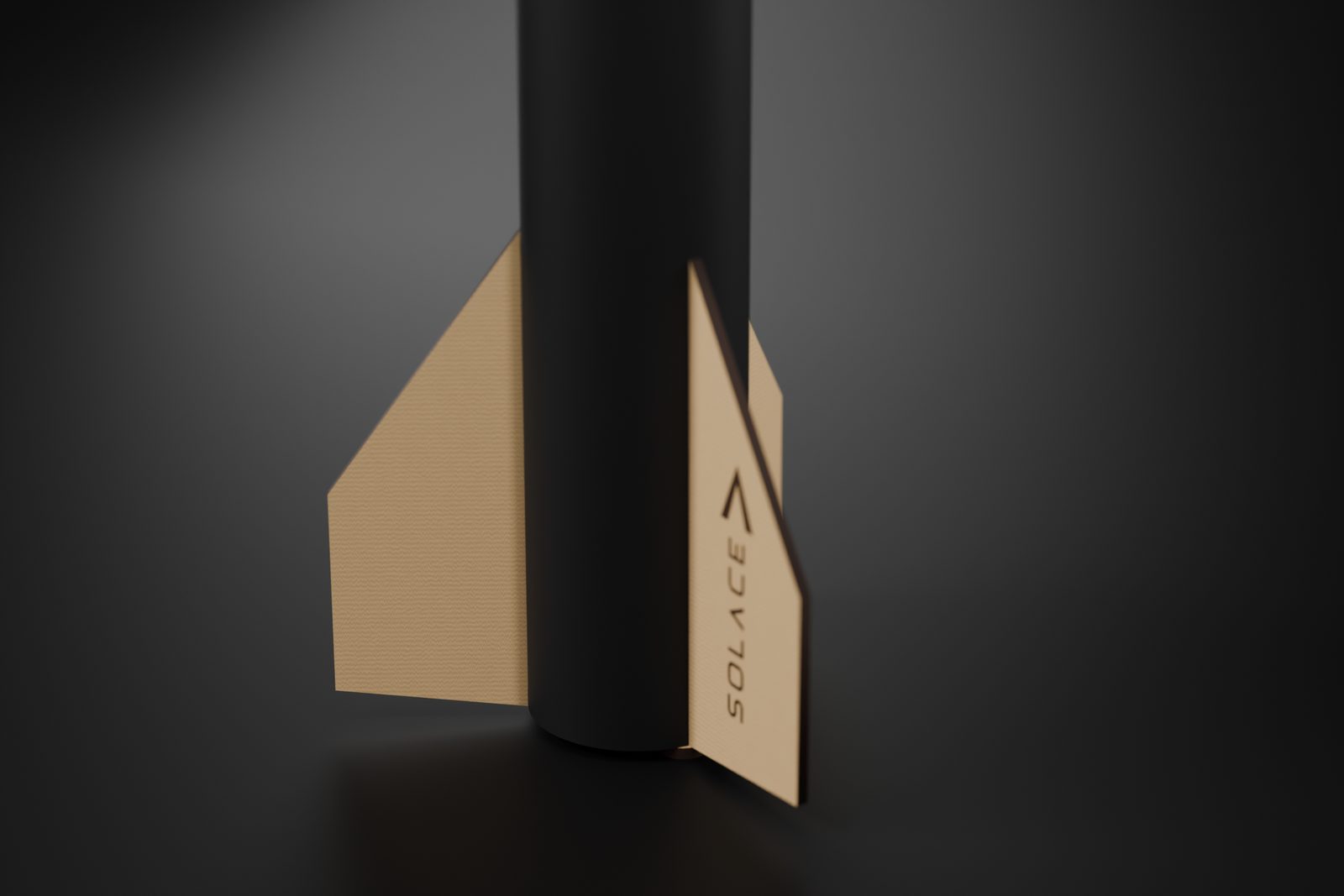
Solace is an 800 mm rocket with a 57 mm body. It has three plywood fins that go right through slots in the body tube, with a tab that runs down inside to the motor tube and is glued there. The fins are 3.2 mm birch plywood, a laser grade board. We cut on a Sculpfun S9 Pro, a 10 W diode laser with a 400 by 410 mm bed. The plywood measured 3.2 mm with calipers, not the 3.3 mm we first guessed. Measure yours, because the thickness decides the slot size.
Each fin is a trapezoid. The root runs along the tube, the tip is the outer edge, the span is how far it sticks out, and the sweep is how far the tip is shifted back along the root. The through-the-wall tab is extra to these.
Source: NOVTAR Solace design file (design values).
Data table
| Item | mm |
|---|---|
| Root | 130 |
| Tip | 55 |
| Span | 50 |
| Sweep | 70 |
By our arithmetic each fin's flat area, root plus tip halved and multiplied by the span, is (130 + 55) / 2 x 50 = 4,625 mm², about 46 cm². That is an estimate from the design numbers, before the tab.
Why cut a test card first
Cutting real parts before you know the kerf (the width of material the beam removes), the plywood thickness and the tube sizes wastes plywood. Our test card has four things:
- A kerf comb. Ten pieces pushed together, whose measured length gives the kerf: kerf = (100 minus the measured length) divided by 10, in millimetres.
- Slots from slightly under to slightly over the plywood thickness. You pick the one that holds the plywood snugly.
- Bolt holes at M2.5, M3 and M5, which should pass the bolts without force.
- The smallest engraving we use, to check fine detail reads clearly without burning through.
For our plywood, the 3.2 mm slot took the plywood with a slight wobble and the 3.1 mm one needed a little force, so we chose the 3.2 mm slot. Our kerf comb reading was unclear when it was written down, so the slot fit set the kerf at about 0.1 mm and it needs measuring again. We have not yet checked the bolt holes.
Finding the cut settings
We ran a material test grid of squares at different speeds and numbers of passes, all at full power, on a scrap of the same plywood. Here is the fewest passes that cut a square free at each speed we tried:
Squares dropped out at 150 and 200 mm/min with 3 or 4 passes, and at 300 mm/min with 4 passes, but not with 1 or 2 passes at any speed, and not at 300 mm/min with 3. Speeds in between were not tested on their own.
Source: NOVTAR bench notes, 19 November 2026, one laser and one batch of plywood.
Data table
| Item | passes |
|---|---|
| 150 mm/min | 3 |
| 200 mm/min | 3 |
| 300 mm/min | 4 |
We first chose 250 mm/min with four passes, between two settings that both cut through, to char less. Then we ran the real fins.
| Job | Setting we used |
|---|---|
| First fin cut | 100 per cent power, 250 mm/min, 4 passes |
| After the fins | Slower: 100 per cent power, 200 mm/min, 4 passes |
| Engraving | 50 per cent power, 2000 mm/min |
Several faster passes beat one slow pass for us because the wood cools between passes and chars less. The cut runs pass by pass over the whole sheet, not all passes on one line at a time, for the same reason.
What went wrong
On the real fins, four passes at 250 mm/min freed the top edge easily but the bottom held on, and a fifth pass freed it with charred edges. So we slowed to 200 mm/min with four passes. The lesson is that a test square cutting out is not proof that a long fin outline will, because the plywood is not the same everywhere. Screw the sheet down so it cannot move between passes.
The first strip was also cut for the earlier tube sizes, a 50 mm body and a 36 mm motor tube, so its tab was 8.35 mm deep. Solace's design has since moved to a 54 mm inner diameter, and the fins are redrawn from the design file, so we will cut the real set after the tubes are measured. Cutting after measuring is cheaper than cutting twice.
How we engraved both sides
A fin has a mark and a name engraved on both faces. We cut a pocket in the same strip, the fin outline mirrored. After a fin is cut you turn it over, drop it in the pocket and engrave the second side. Each fin took about 1.7 minutes to engrave. For scale, here is how long each stage took:
The test card was cut quickly (slots, kerf comb and holes only) because we were short of time.
Source: NOVTAR bench notes, 19 November 2026.
Data table
| Item | min |
|---|---|
| Material test grid | 20.1 |
| Quick test card | 15.5 |
| Engraving one fin side | 1.7 |
Staying safe with a laser
A laser makes smoke and a fire risk. The rules in our build book:
- Wear laser safety glasses made for your laser's wavelength, and keep the shield in place. Anyone else in the room needs them too.
- Vent the smoke outside with a window fan or an extractor duct. Plywood smoke is irritating and the glue in it is not good to breathe.
- Keep a fire extinguisher or fire blanket within reach, and never leave the laser running, even for a minute.
- Use air assist if you have it, for cleaner cuts and fewer flare-ups.
- Cut only plywood, paper and card. Never cut PVC or vinyl, which give off chlorine gas.
- Have an adult around for the first sessions.
Fins and the UKRA rules
The UKRA Safety Code asks for materials and joints that suit the forces in flight, and says to avoid sharp edges, particularly on nose cones and fin edges. Round and sand the leading and trailing edges after cutting, and check the fin joints for strength before flight. The code is the rulebook for club flying, and the Range Safety Officer inspects every rocket: UKRA Safety Code.
Questions
Can I use plywood for laser cutting?
Yes, plywood cuts on a diode laser, but the glue in it matters: smoke from plywood is irritating, so vent it outside. We cut 3.2 mm laser-grade birch plywood on a 10 W diode laser at 200 mm/min with four passes. Never cut PVC or vinyl, which give off chlorine gas.
How do I find the right laser settings for plywood?
Run a material test on a scrap of the same board: squares at different speeds and numbers of passes, then pick a setting that cuts through with a little to spare. Then cut a test card for the kerf and the slot fit before any real part. Our own settings are in the table above and are only a starting point.
How thick can a diode laser cut?
We only know our own case. A 10 W diode laser cut 3.2 mm plywood for us in three or four passes at 150 to 300 mm/min. We have not tested thicker boards.
What is kerf and why does it matter?
Kerf is the width of material the laser beam removes. It makes the cut part slightly smaller than drawn, so slots and tabs need allowing for it. Measure it with a test comb and put it in the design.
Do laser-cut fins need to be flat?
Yes. A warped fin pushes the rocket off its line. Keep the plywood flat, screw the sheet down for cutting, and check each fin sits square to the tube when you glue it.
For what fins actually do in flight, see what do fins do on a model rocket.
Where to get the files and what to read next
The Solace laser files and build book are on the Solace laser files page and the build book. Before flying, check the rocket is stable (how to check CG and CP) and read how a UKRA club launch works. The whole path from rules to launch day is in how to build a model rocket in the UK.