Updated 2026-11-27 · 4 min read
Where does this come from?
The facts are from two NASA Glenn Beginner's Guide to Aeronautics pages, "Aerodynamic Forces" and "Lift Equation", both read on 27 November 2026. Anything marked "our arithmetic" is ours.
How does air push on a rocket?
NASA says that when a solid object sits in a fluid, the "point of contact" is every point on its surface, and the force passes through the fluid pressure. The force on a small patch equals the pressure times the area of the patch. Pressure acts at right angles (normal) to the surface, so the direction of the force changes from the front of the rocket to the rear and from one side to the other.
Why is there a net force at all?
NASA says that if the pressure on a closed surface were the same everywhere, there would be no net force, because every patch has another patch facing the opposite way. Moving air has different speeds at different places around the body. The local pressure is related to the local speed, so pressure varies and the patches no longer cancel. Adding up the pressure times area over the whole surface gives the net force.
What are lift and drag?
NASA defines them from the flow direction. The part of the net force perpendicular to the flow is lift. The part along the flow is drag. NASA calls these definitions. In reality there is a single net force, which acts through the average location of the pressure variation, the centre of pressure. For why that point matters, see model rocket stability: CG and CP.
How is lift calculated?
NASA says lift depends on the air density, the square of the speed, the viscosity and compressibility of the air, the area the air flows over, the shape of the body and its angle to the flow. To handle all of that, engineers use a single number called the lift coefficient (Cl). The lift equation is: lift equals Cl times the density times half the speed squared times the area.
NASA says that for simple shapes and small angles Cl can be worked out mathematically, but in general it is measured by experiment. It also says that density times speed squared over two is the dynamic pressure, which appears in Bernoulli's pressure equation. Our guide on max Q covers dynamic pressure.
Our arithmetic from the equation: because speed is squared, doubling the speed makes the lift, for the same Cl, four times larger.
Why do rockets get measured in wind tunnels?
NASA says working out the speed of the air around a coasting rocket is particularly hard because the flow normally separates at the nozzle end. So engineers usually build a model, measure the aerodynamic force in a wind tunnel, and use the lift and drag equations to scale the force from test conditions to flight conditions.
Where do the forces act on a model rocket?
Our guide on the four forces on a model rocket shows where weight, thrust, lift and drag act. For the drag part, see where the drag on a model rocket comes from.
What about NOVTAR Solace?
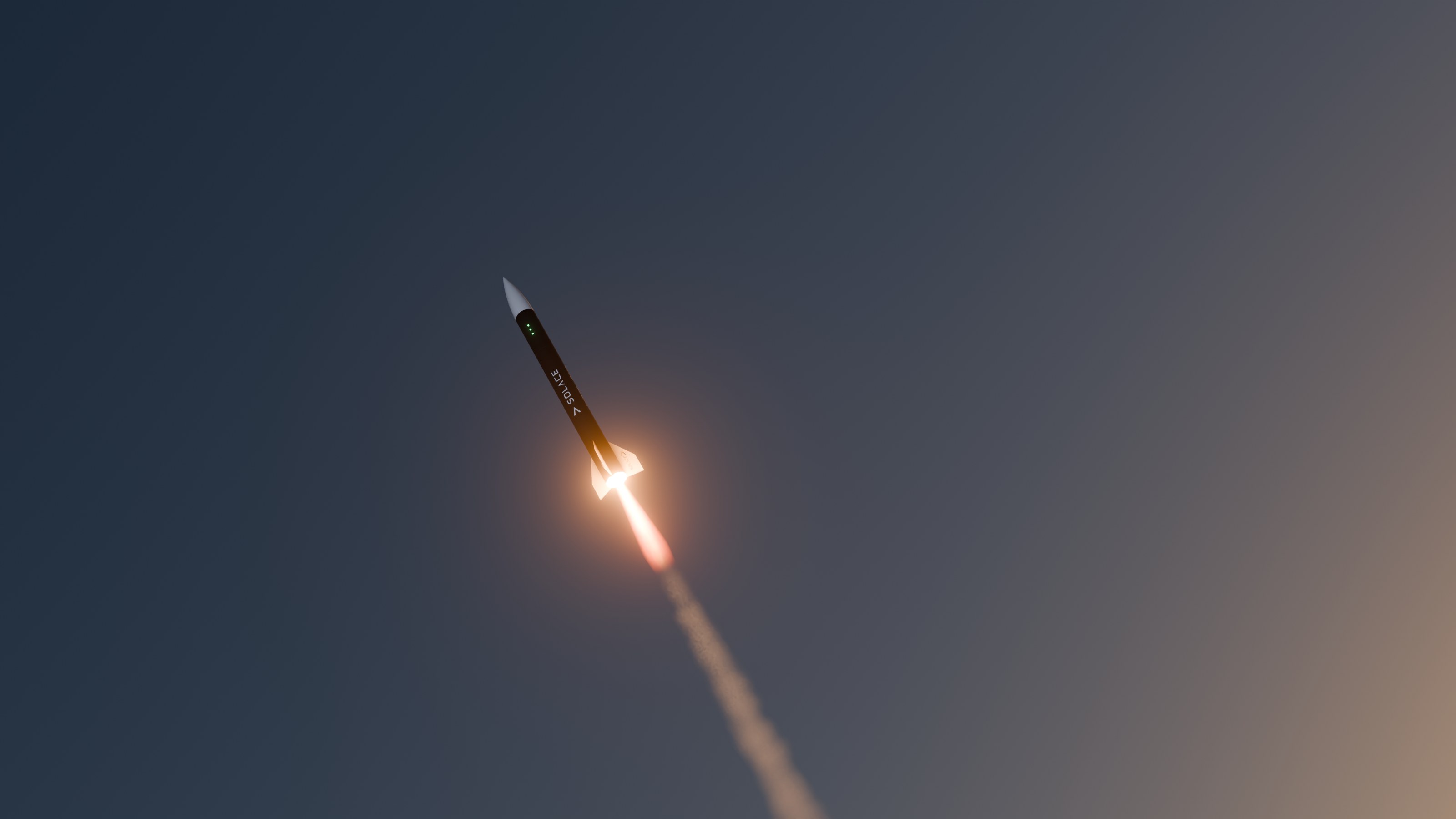
NOVTAR Solace is in design and has not flown. This guide makes no claim about its lift or drag. It is planned to fly at a UKRA club launch under a Range Safety Officer.
Questions
Where does the aerodynamic force on a rocket come from?
NASA Glenn says it comes from the air pressure acting on every point of the surface, always at right angles to it. Adding up the pressure times area over the whole body gives the net force.
What is the difference between lift and drag?
NASA says lift is the part of the net aerodynamic force perpendicular to the flow, and drag is the part along the flow.
What is the lift equation?
NASA gives it as lift = lift coefficient x density x (speed squared / 2) x area.
What is the lift coefficient?
NASA says it is a single number that collects the effects of shape, angle, viscosity and compressibility. It is usually found by experiment.
Why is a rocket tested in a wind tunnel?
NASA says the flow around a coasting rocket is hard to work out because it separates at the nozzle end, so engineers measure a model and scale the forces to flight conditions.
Has NOVTAR Solace flown?
No. NOVTAR Solace is in design and has not flown.
Next steps
- Four forces on a model rocket
- What is a boundary layer, and why does it matter?
- What do fins do on a model rocket?
- What is the Bernoulli equation for air flow?
Read the originals: NASA Glenn, Aerodynamic Forces and Lift Equation.