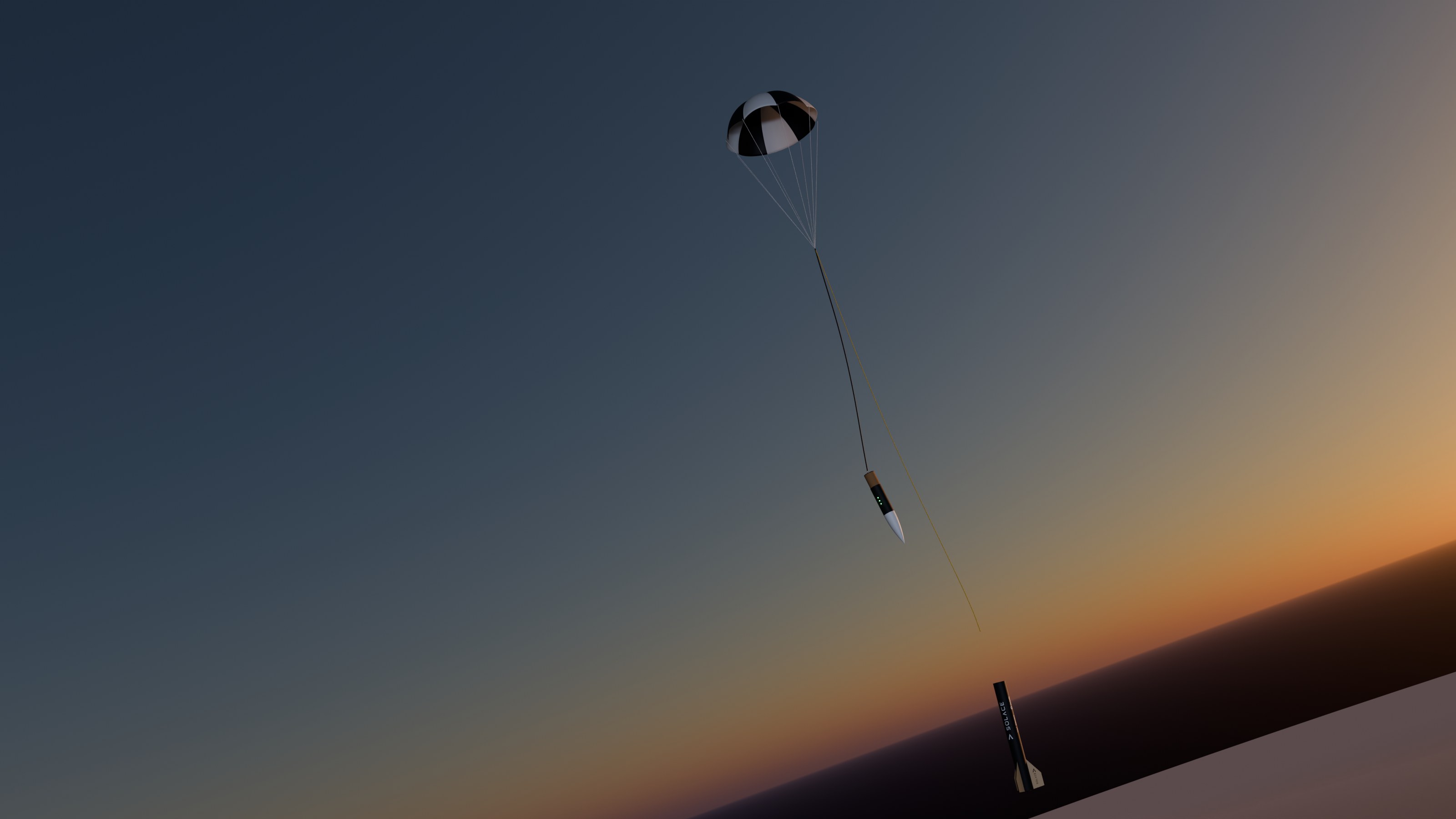
Updated 2026-11-28 · 3 min read
What is terminal velocity?
NASA Glenn explains that a falling object has two forces on it: its weight and the drag of the air. Drag grows with the square of the speed, so a falling object soon reaches a speed where drag equals weight. With no net force there is no acceleration, and the object falls at a constant speed, called the terminal velocity.
What is the equation?
NASA gives the drag as D = Cd x density x V squared x area / 2. Setting drag equal to weight (W) and solving for speed gives V = sqrt(2W / (Cd x density x area)). Here Cd is the drag coefficient, which our drag coefficient guide explains, and the area is the cross-sectional area.
What does that mean for a parachute?
NASA says an object with a large area or a high drag coefficient falls more slowly than one with a small area or low drag coefficient. A large flat plate falls slower than a small ball of the same weight. With the same area and drag coefficient, the lighter object falls slower. This is the whole job of a parachute: it adds area and drag so that terminal velocity is low. NASA adds that Galileo's finding, that all objects fall at the same rate, applies only in a vacuum, where there is no air resistance.
Two worked examples
These are our arithmetic, with assumptions we chose, not measurements. Air density is 1.225 kg per cubic metre (sea level) and gravity is 9.81 m/s squared.
| Case | Assumptions | Terminal velocity |
|---|---|---|
| Rocket falling with no recovery | 100 g, 24 mm body, Cd 0.75 (NASA's typical model rocket value) | about 69 m/s |
| Same 100 g rocket under a canopy | 30 cm canopy, Cd 0.8 | about 5.3 m/s |
A real rocket would tumble and differ from both, and NASA warns that near the speed of sound the drag coefficient rises, so take large speeds with care. See our Mach number guide. The UKRA Safety Code asks that a rocket returns safely, so read our recovery guide for how a canopy is sized.
Questions
What is terminal velocity?
The constant speed a falling object reaches when drag equals its weight, so there is no more acceleration, says NASA Glenn.
How do you calculate terminal velocity?
NASA gives V = sqrt(2W / (Cd x air density x area)), where W is weight, Cd is the drag coefficient and area is the cross-sectional area.
Why does a parachute slow a rocket?
It adds area and drag, and NASA says a larger area or higher drag coefficient makes an object fall more slowly.
Do heavier rockets fall faster?
With the same area and drag coefficient, yes. NASA says the lighter object falls slower.
Do all objects fall at the same speed?
NASA Glenn says that is true only in a vacuum, where there is no air resistance. In air, drag depends on area and drag coefficient, so a large flat plate falls slower than a small ball of the same weight.
What happens to terminal velocity if the parachute area doubles?
Our arithmetic from NASA's equation: area is under the square root, so doubling it with everything else equal divides the speed by about 1.4 (the square root of 2), not by 2.
What is the terminal velocity of NOVTAR Solace?
NOVTAR Solace is in design and has not flown, so we have no measured descent speed. See our recovery guide for the design sum.
Next steps
- Model rocket recovery in the UK
- What shape should a model rocket parachute be?
- How far will a model rocket drift?
- Do heavy objects fall faster? NASA Glenn explains
Source: NASA Glenn Research Center, Terminal Velocity (read 26 November 2026). Read the code before you fly: UKRA Safety Code.