Updated 2026-11-27 · 3 min read
Where does this come from?
The explanation is from NASA Glenn Research Center's "Free Falling Objects" page in the Beginner's Guide to Aeronautics (last updated 20 November 2023, read on 27 November 2026). Comments marked as ours are not NASA's.
What is free fall?
NASA says an object that moves because of gravity alone is in free fall. In a vacuum the only external force is its weight, and the weight equation gives weight as mass times g. NASA gives g as 9.8 metres per second squared (32.2 feet per second squared) on the surface of the Earth, with different values on the Moon and Mars. The mass of an object does not depend on where it is, but its weight does.
Why do all objects fall at the same rate?
NASA uses Newton's second law, force equals mass times acceleration. For a free-falling object the net force is its weight, mg, so the acceleration is mg divided by m, which is g. The mass cancels. NASA states that mass, size and shape are not factors, so all objects free fall with the same acceleration.
What changes when there is air?
NASA says that if the object falls through an atmosphere, there is an extra drag force and the motion is more complex than in free fall. This part is our link to rocketry: a model rocket coming down on a parachute is not in free fall, because drag is large. Our guide on terminal velocity for a model rocket covers the speed where drag balances weight, and the four forces guide covers weight and drag together.
Why do astronauts float?
NASA's example is a Space Shuttle in orbit and an astronaut on a spacewalk. They have very different weights, sizes and shapes, but gravity is the only force on both, so both are accelerated towards the Earth at the same rate. NASA says that at a 200 mile orbit the acceleration is about 90 per cent of the surface value. Because they fall together, the astronaut appears weightless and floats relative to the Shuttle.
Did Galileo drop cannon balls from the Tower of Pisa?
NASA says the observation that free-falling objects share one acceleration was first proposed by Galileo nearly 400 years ago. He rolled balls down an inclined plane and found that the distance depended on the square of the time, whatever the mass of the ball. NASA says the story of him dropping two cannon balls from the Leaning Tower of Pisa is just a legend.
What about NOVTAR Solace?
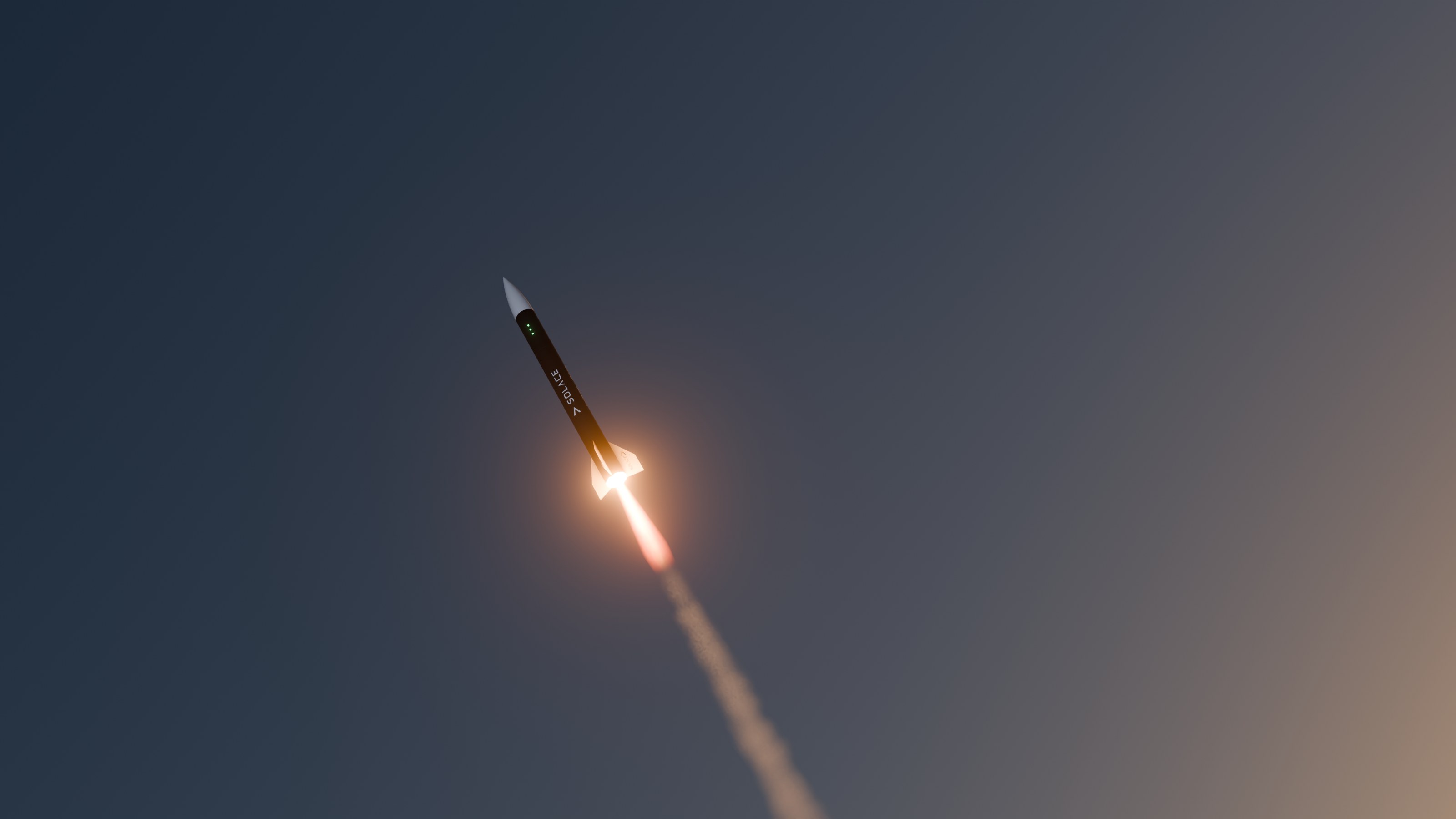
NOVTAR Solace is in design and has not flown. Once its motor stops, NASA's ballistic flight idea applies only if drag is small. NOVTAR Solace will fly on a certified motor at a UKRA club launch under a Range Safety Officer.
Questions
Do heavier objects fall faster?
Not in free fall. NASA Glenn shows that the mass cancels out, so all objects with only gravity acting on them accelerate at the same rate, g.
What is the value of g?
NASA Glenn gives 9.8 metres per second squared (32.2 feet per second squared) at the surface of the Earth. It has different values on the Moon and Mars.
Why does a parachute fall slower than a rock if all objects fall at the same rate?
Because they are not in free fall. NASA says that in an atmosphere there is an extra drag force, which makes the motion more complex.
Why do astronauts appear weightless?
NASA says the astronaut and the Shuttle both fall towards the Earth with the same acceleration, so the astronaut floats relative to the Shuttle.
Did Galileo drop cannon balls from the Leaning Tower of Pisa?
NASA says that story is just a legend. Galileo's experiments used a ball on an inclined plane.
Has NOVTAR Solace flown?
No. NOVTAR Solace is in design and has not flown.