Updated 2026-11-27 · 4 min read
Where does this come from?
The facts and the formula are from NASA Glenn Research Center's "Flight To Orbit" page in the Beginner's Guide to Aeronautics (page last updated 20 November 2023, read on 27 November 2026). The working-out in the table is our arithmetic, marked as ours.
How fast does a rocket have to go to stay in orbit?
NASA gives the speed for a circular orbit as V = the square root of (g0 x Re squared / (Re + h)). Here g0 is the pull of gravity at the surface (32.2 ft/sec squared), Re is the mean radius of the Earth (3,963 miles) and h is the height of the orbit in miles. NASA works one example: for a 100-mile-high orbit the speed is 17,478 mph.
Does a higher orbit need more speed?
No, less. NASA says that as the height above the planet increases, the speed needed to hold an orbit decreases, so a spacecraft in a lower orbit must travel faster than one in a higher orbit. The page also gives a formula for the time of one orbit, T squared = 4 x pi squared x (Re + h) cubed / (g0 x Re squared).
Our arithmetic, using NASA's numbers in the two formulas:
| Height of circular orbit | Speed (our arithmetic) | Time for one orbit (our arithmetic) |
|---|---|---|
| 100 miles | 17,479 mph | about 88 minutes |
| 200 miles | 17,268 mph | about 91 minutes |
The 100-mile speed matches NASA's own 17,478 mph apart from rounding. We checked the 100 and 200 mile rows ourselves; NASA's page only states the 100-mile speed.
Is reaching space the same as reaching orbit?
No. NASA says orbital flight is a combination of altitude and horizontal velocity. It notes that the SpaceShipOne flight reached the height needed to "go into space" but lacked the horizontal speed needed to "go into orbit". A rocket that only goes straight up falls back down.
How does a launcher get there?
NASA describes a typical two-stage launch like this:
- The engine thrust is greater than the weight, so the rocket accelerates away from the pad.
- It climbs vertically and leaves the thick air near the ground quickly. Drag stays small even at supersonic speed because of the rocket's shape and the thin air at height.
- It begins to pitch over, so the flight path leans away from the vertical.
- Several minutes into the climb, most launchers drop weight by staging, often lighting a second engine. The spent first stage falls back on a ballistic path.
- The lighter upper stage keeps accelerating and pitches over towards the horizontal.
- At a carefully chosen height and speed the upper stage engine is cut off, and the stage and payload are in orbit.
NASA also says aerodynamic forces matter less for satellite launchers than for toy and model rockets, because the rocket leaves the atmosphere as quickly as it can and then builds up the speed it needs. Full-size launchers also use a guidance system and a gimballed (rotated) engine to steer, which model rockets do not have. Our guides cover serial and parallel staging and rocket guidance systems.
Astronauts in orbit are not beyond gravity: see does a rocket weigh less in orbit?
What does this mean for a model rocket?
A model rocket on a certified motor stays far below orbital speed and height, and it comes back down under a recovery system. NASA's page says two-stage model rocket kits exist but that they cannot fly all the way to orbit. Our guide on model rockets and real rockets lists the differences, and the ideal rocket equation guide shows how a rocket's speed gain depends on its exhaust speed and mass.
What about NOVTAR Solace?
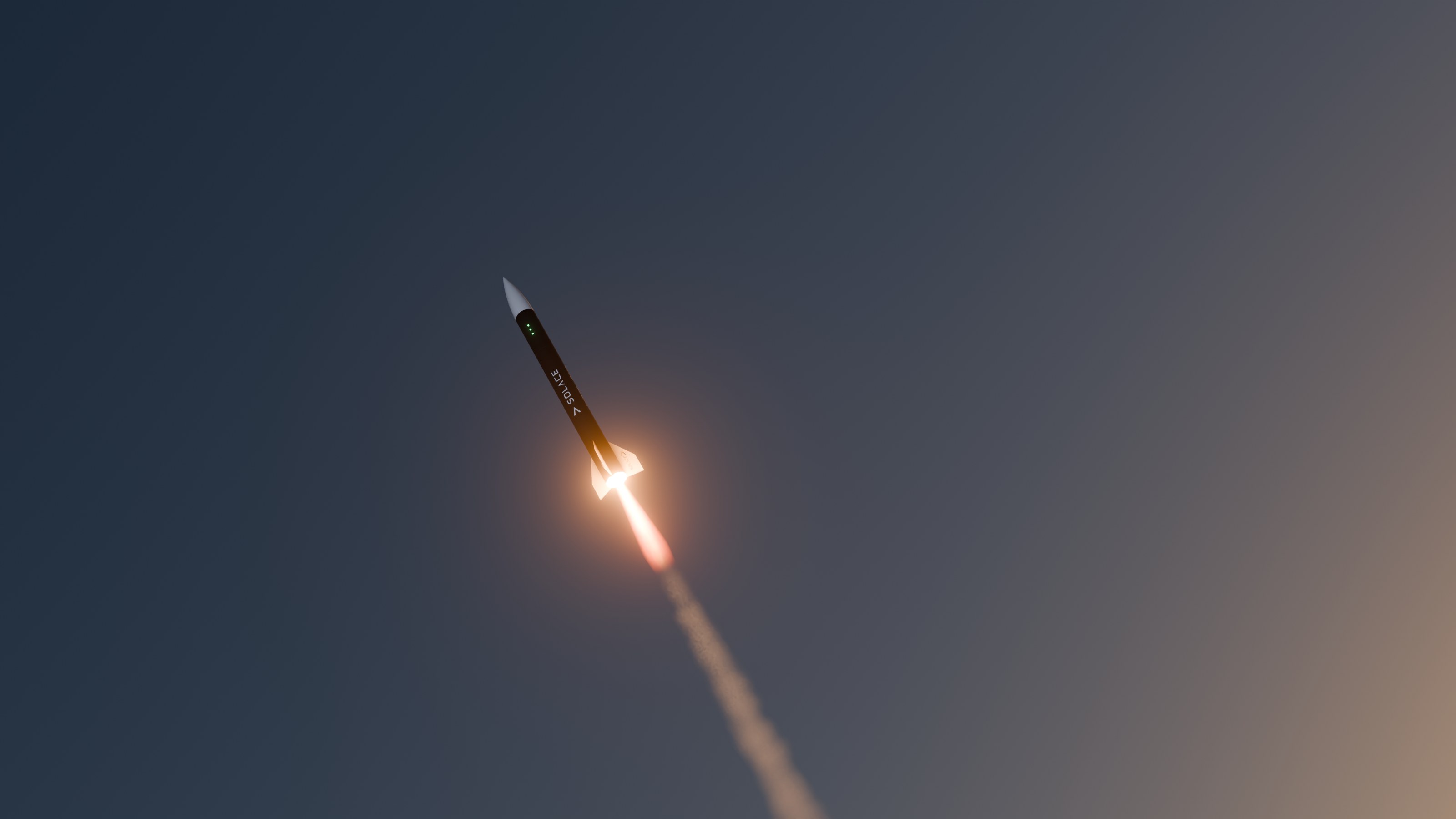
NOVTAR Solace is in design and has not flown. It is a model rocket that will fly on a certified motor at a UKRA club launch under a Range Safety Officer. It is not an orbital rocket and does not try to be one.
Questions
How fast does a rocket have to go to reach orbit?
For a circular orbit 100 miles above the Earth, NASA Glenn gives a speed of 17,478 mph. The exact speed depends on the height of the orbit.
Is reaching space the same as reaching orbit?
No. NASA says orbital flight needs both altitude and horizontal speed. SpaceShipOne reached the height to go into space but lacked the horizontal speed to go into orbit.
Does a higher orbit need more speed?
No. NASA says the speed needed to hold an orbit decreases as the height above the planet increases, so a lower orbit needs more speed.
Can a model rocket reach orbit?
No. NASA says two-stage model rocket kits exist but cannot fly all the way to orbit. A model rocket flies on a certified motor and returns under a recovery system.
Has NOVTAR Solace flown?
No. NOVTAR Solace is in design and has not flown.