Updated 2026-11-28 · 4 min read
Where does this come from?
The facts are from one NASA Glenn Research Center page, "Gas Density" in the Beginner's Guide to Aeronautics, read on 28 November 2026. Anything marked "our arithmetic" or "our reading" is ours.
What is density?
NASA defines it as the mass of an object divided by its volume. Its everyday example is that a brick and a loaf of bread are about the same size, but the brick is heavier because it is denser. NASA adds that aluminium is less dense than iron, which is why aeroplanes and rockets use it.
Why does the density of a gas change so much?
NASA says that for solids the density of a pure material stays fairly constant because the molecules are bound together. A pure gold nugget would have nearly the same density on the Earth or the Moon. For gases the molecules are free to move, so the density can vary widely. NASA says air at the surface has a very different density from air 50 kilometres up, and that understanding density is fundamental to rocket aerodynamics and propulsion.
What do NASA's four cases show?
NASA uses a made-up gas of 26 molecules in a tube. It is a thought exercise, not real air, and NASA gives the cases as a simple illustration:
| Case | What changes | Density |
|---|---|---|
| 1 | Mass 0.52 kg in a 2 cubic metre tube | 0.26 kg per cubic metre |
| 2 | Sample a 1 cubic metre part of the same gas | 0.26, unchanged |
| 3 | Squeeze the same gas into 1 cubic metre | 0.52, doubled |
| 4 | Remove half the molecules from the 1 cubic metre tube | 0.26, halved again |
NASA says case 1 corresponds to the density of air at about 13 kilometres up. Our reading: cases 3 and 4 show the two ways to change density, changing the volume or changing the number of molecules. NASA says a sample of a static gas has the same density as the whole, as long as there are very many molecules moving at random.
Why is the air thinner higher up?
NASA says air molecules near the ground are held together more tightly than those higher up, because of the pull of gravity on all the molecules above them. The higher you go, the fewer molecules there are above you, so the confining force is lower. There are fewer molecules and the density decreases with altitude. For the temperature and pressure side of this, see our guide on how air temperature and pressure change with height.
What is specific volume?
NASA says specific volume is the reciprocal of the density (one divided by it). It says specific volume is often used for static gas problems where the volume is known, while density is used for moving gas problems, and that the two are equivalent state variables. NASA says density is a scalar, with a size but no direction.
Why does density matter for a rocket?
NASA's page says density is fundamental to rocket aerodynamics. Our guide on max Q shows how the aerodynamic force depends on the density, and our air pressure guide covers the pressure side. For how a gas changes when its volume changes, see Boyle's law.
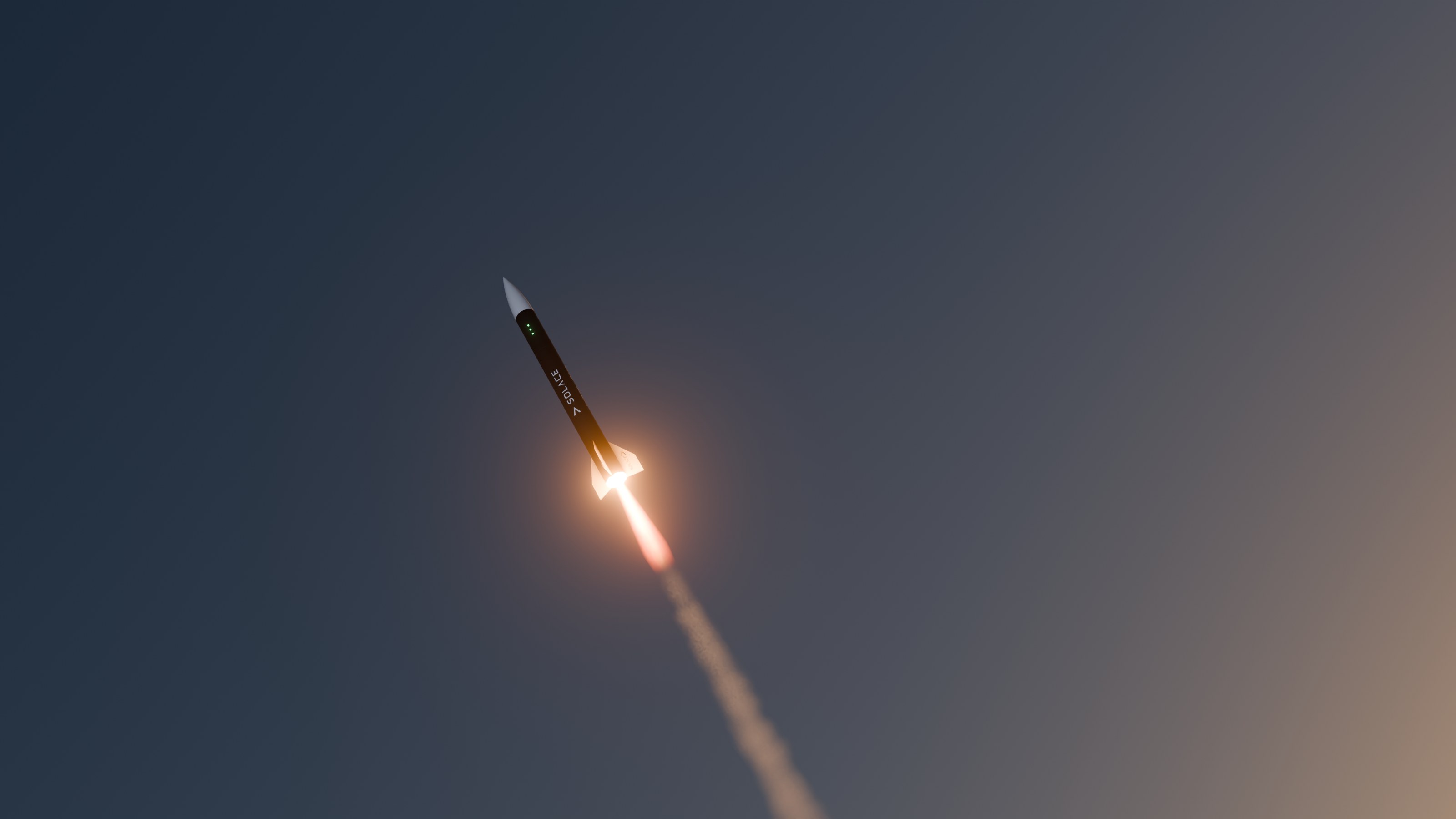
What about NOVTAR Solace?
NOVTAR Solace is in design and has not flown. This guide makes no claim about the air it will fly through. It is planned to fly at a UKRA club launch under a Range Safety Officer.
Questions
What is density?
NASA Glenn defines it as mass divided by volume.
Why does the density of a gas change more than a solid?
NASA says the molecules of a gas are free to move, so its density can vary over a wide range, while the molecules of a solid are bound together.
Why does air get less dense as you go up?
NASA says there are fewer molecules above you at greater height, so the confining force is lower and the density falls.
What is specific volume?
NASA says it is the reciprocal of density. It is used for static gas problems, while density is used for moving gas.
Has NOVTAR Solace flown?
No. NOVTAR Solace is in design and has not flown.
Next steps
- How air temperature and pressure change with height
- What is max Q (maximum dynamic pressure)?
- What is Boyle's law?
Read the original: NASA Glenn, Gas Density.